Wednesday, 17 November 2021

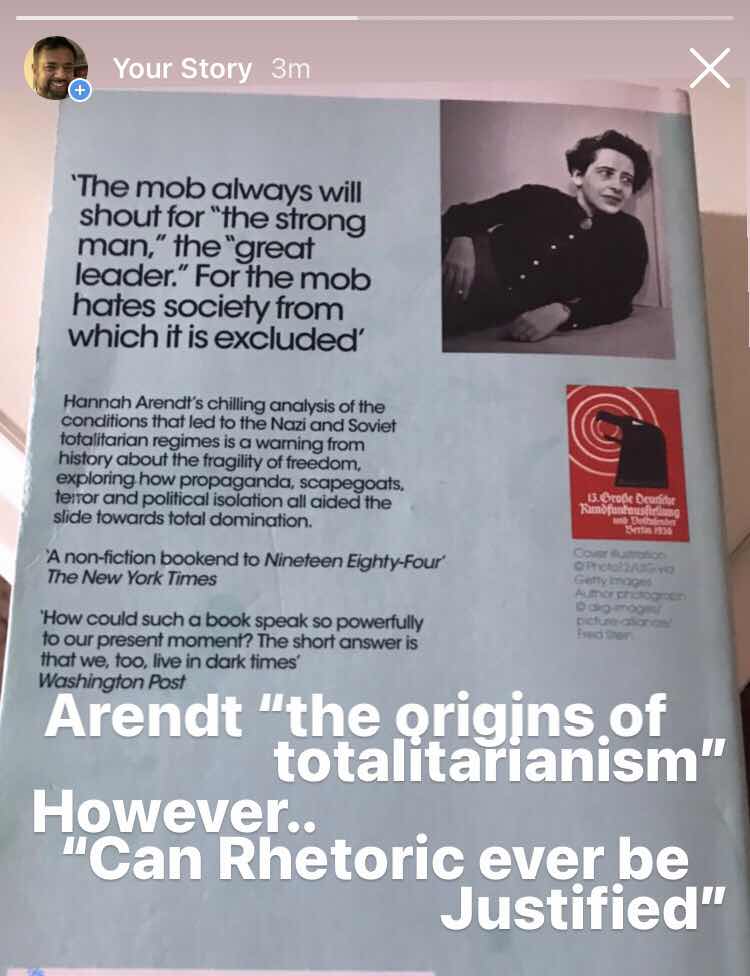
Is Rhetoric ever Justified?

Is rhetoric ever justified?

(^1)

Rhetoric is that which appeals to men’s base characteristics using the facade of argument. (^2 for an alternate definition)


The rhetorician either has it that every argument can be justified, and because of this every argument has the right to gain airtime, so that it can compete in the marketplace of ideas. Or he revels in his ability to pull the wool over the eyes of his fellow man, never once seeking to disclose his skill to scrutiny. 


Politicians who use rhetoric to gain ascendency may also believe that the are justified in doing so, because if they did not then another, without the wherewithal to affect real change for the better, would gain ascendency over them. 


In all cases rhetoric is used to exert control, those are its means, and not to educate nor uplift another. 


It is only very few who espouse rhetorical ideas that actually believe them. Except for those that repeat them verbatim without thought, or ability to scrutinise them. 


Did Hitler really believe that Jews were the source of all evil, or did he simply espouse so out of revenge, for a perceived injury, and to spite them?


Before Zionism adopted the Star of David for its symbolism, and conflated anti-Semiticism with anti-Zionism, did they really see their Arab hosts in the Holy Lands as inherently evil?


It was only with their adoption of “the chosen People” (^3) status that their espoused World-view (amongst themselves) changed to one of evil, before that everything was about operational necessity. Even that is Zionist sanctioned terrorism that saw them bomb a hotel housing British servicemen, that eventually saw Britain quitting from the Palestine. 


Rhetoricists may argue that they pander to the needs of the people. 

People naturally want answers, and the blame game is an easy escape, and an all too easy answer, as is all rhetorical argument that simplifies things. 


But it is because of that, that it’s just to easy, that rhetoric can never be justified. 

Except by men (to themselves) who want to turn other men’s will to their own. 

Who seek power for themselves, and are not for the greater good. But even when they seek it not for themselves, they are not aware that any concentration of power carries with it the commensurate risk of actual and real tyranny. That rhetoric, in general, is used to appeal to and thereby cements power and authority. 


Indeed all social organisations, from the family upwards are made up of individuals. 


And each individual person carries a moral responsibility. Rhetoric does nothing to help them in discharging that moral duty, and in fact deadens them to it. 


So yes rhetoric does need airtime, but only sufficient and within the context of debaunching them.  

Only within the context of making us alive to it’s threat. 


And the threat of those that justify exploitation and oppression. 


When Churchill raised England to fight against facist Germany, did our boys (and the whole country) fight against facism because of facism, or because it threatened our Nation?


When our very survival is threatened can we justifiably use Nationalist argument, that, when the immediate threat is over, would cause us to descend down the same route that Hitler took?


Are arguments that appeal to our Nationalist sensibilities, that we are better and more deserving than others, ever justifiable?


The short answer is not if you are a believer, and believe in the Oneness of God and the commensurate oneness of Mankind. 


END

^1 This has only just become a pressing question for me because of late I have Conservative Politicians that I like. And that on a personal level. And yet we are all equally capable of good, as we are to wrong. The question then is about whilst you can good on an individual level, can that really justify harming people’s ability to think for themselves?


^2 It’s dictionary definition may well be that it is argument that purposely uses logical fallacies, aimed at pulling the wool over the eyes of fellow men, stymieing them into stupidity. 


Or according to the Oxford Dictionary...

TBC 


^3 The question of who copied who is a moot point. 

Tuesday, 9 November 2021

How do you not know that God hasn’t already forgiven them?

*”O Allah show us the truth as the truth and bless us that we might follow it, and show us falsehood as falsehood and bless us that we might refrain from it” A true supplication of the Messenger of God.*

Such was one of the supplication that the Messenger of God (saw) used to make for himself. 


Many will rightly interpret the supplication as being there to teach us to follow the truth and leave off from falsehood. 

Just as the Messenger (saw) used to do one hundred istighfar, to teach us the importance of it and yet he was masoom- innocent of all wrong. 


When we think deeply about the religion, and not superficially, then we would see that istighfar is more about creating a humble mindset than anything else. 


That we ask because we each have the capability to wrong, and asking forgiveness helps to prevent us from that. Because istighfar nurtures humility in us, and also opens for us the doors to God’s mercy. ^1


 Indeed contemplation is the gateway to closeness to God. For our religion is rich with such opportunity. It’s in the signs of God, evident in His greatest handiwork (the cosmos), ourselves and the revelation, and His religion that are ripe with such opportunity. 


So when we consider the supplication at a deeper level we would recall that “truth is clear from falsehood”, a verse that follows on from the greatest of verses in the Quran (Ayat’ul Kursi).^2


And that the Messenger of God had both Worlds opened for him, and so cosmological truth would have been self evident and natural to him. 


So since the above supplication was for himself we have a duty to think deeply to plume the depths of it’s meaning. ^3


And indeed the supplication of a Messenger is always answered. 

This means that to find the answer to this conundrum we might first look to the Seerah of the Messenger (saw) and his life. 


It is unfortunate that many of our scholar whilst well versed in the Quran, and in fuss’at Arabic neglect contemplating the Seerah. 


For did not God call it the Wisdom in His revelation. But for most of them they do not contemplate, nor think deeply. 


Then you must ask yourself who would you rather follow the whole World and their interpretation, or the Messenger of God (saw) and his interpretation? ^4a & ^4b


[What I mean by this is that how the Messenger (saw) interpreted the supplication would be present within his action. For supplication is not simply that, it is also action that is inspired by that supplication. And that is ripe and ready for you to contemplate.]


The truth that is referred to in the Messenger’s (saw) supplication is not so clear as day and night. 


Rather it is the reason we have been given life, and free will, in the first place. 

For did not God say “indeed we created death and life to know which of you is best in deeds” and “This is a day on which the truthful will profit from their truth”. (S Mulk v1) (S Maedah v119).  


And it is this truth which becomes clear at times of tribulation and hardship. 


Contemplate then the case of a man who betrayed the Messenger (saw) of God?


For when Quraysh broke the Peace treaty between them, and the Messenger (saw) concluded at the behest of one of his allies, that he must take action against this breach of trust, he determined to march on Mecca. 


Jibreel (as) (the Angel Gabriel) came and informed him of a message sent to Quraysh to warn them of their imminent danger. 


The message was intercepted. 

And Umar (ra) asked of the Messenger (saw) permission to go and cut off the head of the traitor who had dispatched the message. He had done so because part of his family yet remained in Mecca and he wanted either for them to be protected, or for them to curry favour with their people. 


Now look at the Messenger (saw) and his response to Umar’s (ra) enquiry. 


O Umar, he was one of those who fought a Badr. What makes you not think that God hasn’t already forgiven his future sins?


Indeed the battle of Badr was a great trial from God, where 300 scantily clad, and poor mainly Muhajir, stood against 1000 well armed warriors of Quraysh with steeds of war. 


Those who fought there were worth their weight in gold, and even more than that; for they had proved their truth. 


And this then is the supplication of the Messenger (saw), for to know the truth of men is a difficult thing. 


But when you find one who is true, then his worth is like that man who betrayed the Messenger (saw) and was forgiven because of his words- “how do you not know that God hasn’t already forgiven him?”


They are like jewels on the Earth. 

And such people, you should take them as your friends and be good and kind to them, for their worth is immeasurable, no matter who they are. 


And so we also see the Messenger (saw) desperately wanting to find the truth of his people at the battle of Tabuk. 


For that was one of the hottest months on record, and Rome threatened Medina from the North. So the Messenger determined to muster his warriors to the North at Tabuk. There were no standing armies and each man was responsible for his own ride, armour and weaponry. 


The Messenger (saw) arrived at the oasis of Tabuk. And there we find him eagerly looking to the horizon. He did not look nor worry about the threat from Rome. Rather he looked south, and was eager to see Abu Dharr al-Gofari (ra). 


Read the Seerah, and read about how Abu Dharr fulfilled his obligation and made it to Tabuk. And feel how the Messenger (saw) must have felt pleased that his truth had been proved. ^5


And so we also find this quality of the Messenger mentioned in v128 of S Taubah:- full of compassion and concern for the believers, that they would not fall into hypocrisy because of the trails that will be meted out to them once or twice a year. (Read Taubah- from v 123).  


Then this is the meaning of show me the truth as the truth, and bless me that these people are part of my life. 

(I’m not a linguist but the root of the word used in the supplication appears to be risq- sustenance- then it is- O Allah let them be part of the ways through which you sustain me, and me them. Aameen). 


For in the last verse of Taubah we see the Messenger indirectly admonished as to his compassionate character and then asked to rely on Allah. For the words used are those that we us when a trial is upon us.


Clearly the believers are a trial for the Messenger. ^6


That when we appreciate his words, then we are a blessing for him. 


And so the meaning of the supplication is also, that when you find one who is false and their falsehood is verified because it is no mere mistake that you can overlook, and forgive, know that that person is false. 

And then may God give us the courage to leave off from them. ^7


O Allah bless each of us that You may find the truth in each of us, and protect us from the falseness within each of us, that we may be constantly vigilant against it. 

Aameen. 


END. 


*Knowledge is sought through study and contemplation. Not this above, nor lectures, nor talks*


^1 And so in Surah Nasr which was revealed after the conquest of Mecca, we were commanded to make istighfar (ask God for His forgiveness). 

And at that conquest no one was harmed, and Mecca was taken peaceably, and with the respect it is due. 


^2 So clear that as the verse reads, “There is no compulsion or force in the religion”, because the truth of it is so evident that God does not need to compulse you to believe. 


^3 Indeed when we do think deeply then we appreciate that truth is a cosmological quantity pertaining to the reality of all things as they are. And we learn in the Qur’an that all things do bear witness to God in truth. And God offered freedom of choice and of all things it is, the essence that is, man that accepted it. 


^4a The Sufi pay particular heed to this supplication believing that it talks about the hidden knowledge. 


It is a cornerstone of true Muslim belief, that is mentioned in S Takwir, the Messenger (saw) withheld naught of what he knew. 


We can see this at Israa and Miraj. That the event happened and though people would have rightly scoffed at it, the Messenger (saw) immediately told us concerning the event. 


Indeed a few Muslims left the religion of Islam on hearing about Israa and Miraj. 


 ^4b For when you contemplate then you realise that God’s protection of the Quran extends to His religion, that understanding it is an ever present conundrum. 

So that it has not been fully explained and is fresh for each new generation, as if it had been born yesterday. 


^5 Abu Dharr (ra) took the Shahadah whilst the Messenger (saw) was still at Mecca and before the Hijra to Medina and the establishment of the a Muslim polity. 

He was from a dessert tribe and was not present at the battles of Badr, Uhud or Khandaq. 


If you peruse Shia sources then they will say otherwise because they say that he was one of three who did not leave the religion when Abu Bakr (ra) became Khalifatul RasulAllah. 


^6 And that is also referenced in the last verses of S Hajj. 


^7 it’s as if this is a circular argument that the supplication that we are concerned with is a direct result of the last verse of Taubah. But as with everything to do with the religion, linearity is never so simple. 

That the supplication may predate the verse and explain it. 
Monday, 1 November 2021

How Small Their Interpretation

How small their interpretation 


When a trial touches you

Do you feel that it be an education- 

A refutation of your goodness 

That you might be tamed in the ways of the World 


How small is your interpretation 

That you would accept poverty 

For a richness of soul. 

Do you not think that God’s care extends to you even there?


Then that trial is not a trial of remonstration 

But a trial of your heart to see how much you would believe 

They might up the stakes 

Chase you from wall to wall 


But you know that you are a door 

And because of you 

Not only one will be saved

But many too


Then would you not believe?

In the vastness of God’s mercy 

And that none can touch you 

Except by His leave. 


Then a champion be. 

And do not stop until the many are free 


For God’s intervention and care 

Are not things to be hid

But things to glory in 

And be shared 


So that others can know 

That this is an attainable state 


Strive, 

think, 

live 

and contemplate

And you are half way there. 


Shafees

1st November 2021


Sunday, 31 October 2021

The Man in the Bowler Hat


On the dot at nine O Clock 

The spurious claimant walks past

What a strange behaviour 

From one who said and claimed, the worst 


Of those who did nothing except show an extra kindness 

Does he go to revisit the place of the crime 

Like a criminal that he is, does he go to gloat 

Buoyed by the destruction that he wrecked


Or does he go to bait those that he accused

That when they holler and rebuke 

That man in a suit, 

Who looks like he would not hurt a feather 


Then he would have them sent down 

For malicious communication 

What a stupid reason 

For a force full of corruption 


We do not need to rebuke him 

Nor hurl obscenities 

For the lie is on him 

He is his own destruction. 


Those who auger ill

Ill will they have 

This is true no matter, who 

Each makes their own truth 


And his is a base lie 

That belongs to none but himself 

Let him sleep not easy, 

Nor know any comfort 


Until judgement day. 


END

Shafees Nov 2021


Saturday, 9 October 2021

Shortened Sight

My sight beheld the honeyed plane

In a place where no man would wish to be

It peered towards, infinity 

My sight shortened, and yet saw more


But not by eyes, not these instruments that glow. 

But by another, I cannot know 


Imagine if you but would 

The noblest of us all, rejected, cursed 

And made to run from children throwing stones 

And when the angel did appear to his command 


He offered a chance that their children might right 

The wrong they did that day, etched upon our memories 

So that when all Arabia in turmoil did revolt 

Not so the Children of Taif, they did not bend 


The Messenger’s hopes were well founded

But greater still those words laid out a choice 

Made clear that their chance would appear 

And thus it did and they proved true. 


The power of hope cannot be thwarted

Not by all false religions that brood with fear 

That cause men to wrong, to wrong .. 

and yet think they right. 


That they be justified in their denial 

Of God’s goodness being not restrained 

His hands are not tied, you fools, you lie

But peace is upon those who believe


And they do not have to be your people, your kin.  

No fear with attach to them, nor will they grieve. 


I was given the sight to know. 

That I would protected, in that worst of places 

That I would not stop, nor bend with fear

That I might offer the choice to one other


Who has proved true, this long year all through 

Let not fear, nor obfuscating argument be your screen 

Choose with your heart, and feel real. 


(C) Shafees, London 

9th October 2021

Wednesday, 6 October 2021

Kidney Pains


 My kidney pains 

We start with those things that you know 

That I need to drink more water to flush it through. 


Then after that it stutters, then lurches forward 

The words that is in spasmodic shifts that guile the eyes 

For we were a pair that laughed at each other’s well worn cares


And did not mind what people thought, or if they stared. 

Most definitely the promise of God must be true 

That what comes after must be better than what we’ve been through


Two solitary fingers set alone 

Brought together side to side, before time 

Then pushed apart by sordid jealousies 

Should be together as if they were one 


That promise yet waits for you to call 

The Messenger (saw) who brought pure faith, as true. 

For when you tie your hope on a thing that he said was so. 


Then every trial is only a reason 

To bring further blessings, countlessly so. 

Then put your trust in the source of all goodness. 


And pray that I’m the reason for your elevation.  


Tuesday, 5 October 2021

Nothing comes Free

When we contemplate the exemptions from the five fardh, and what the greatest of our worship asks of us, therein is a great benefit. 


For the Salaat is obligatory for the sane, and only the insane are exempt from it. To the extent that if the call to prayer is made, and you are within the precincts of the masjid that you needs must answer the call and pray the salaat in congregation with the Jamaa’. 


Having prayed before with another Jamaa’ is no excuse. The only excuse is the lack of sanity. 


Furthermore incapacity is itself not an excuse, because in that instance we are to pray with our eyes - make the rukoo and sujood by lowering our gaze. 


The Zakah, poor due, is obligatory on all who hold assets in excess of their immediate need. And therefore it is not due on your home, or your car, or your provision. But it is due on anything that you hold to make a profit on, and on your wealth that you save. 


Interestingly here our society is not predicated, as this is, on misfortune nor the fear of regret of it. Whereas this society encourages saving, our does not. 


The exemption here to pay Zakah is the poor and those that do not have, or have just enough for their own m, and their families, upkeep. 


Sawm, the Ramadan fast, is incumbent on us all as a community. The exemption from it is for the old, infirm, unwell and the traveller. The expiation of which is the feeding of the poor. 


Hajj, our most perfect worship and the last to made clear is incumbent on all who are able and have sufficient means. 


Recently I had the good fortune to take my three sons for Hajj. There I impressed on them that the Hajj that we were doing was NOT their fardh Hajj. For that would require for them to perform it with their own funds and their own hard earned money. 


Of the five, the testimony of faith is incumbent upon all. 


After that the ordained five daily prayers are the most accessible, for did not God make the whole World as a place of sujood for us all. So that when the appointed time arrives, we stand to pray wherever we are. 


And the next that is twinned, nearly always in the Quran, with the established Salaat (prayer) is Zakah (the Poor due). 


And even though the Messenger (saw) made it so easy for the poor to perform charity. For he said even a smile is Charity. And that the prayer is Charity for your bones and your body. And that every step that you take to the Masjid washes away sins. 


Even then the poor of Medina felt keenly that they lacked in that they could not give in Zakah, so much so that they complained to the Messenger (saw). 


And then he gave them the Tasbih. 


That they felt the keenness in the lack of means is telling. Especially when you consider that the Messenger (saw) said that they would be the first to enter Heaven (their questioning being lighter). 


That they understood that the religion is not just lip service. But that the greatest of it is giving, and sacrificing so that another may benefit because of you. That is where you proof lies. The proof of who you are. 


If anything is worth doing then it is worth sacrificing for, paying for it and doing it. 


Indeed that which differentiates us from the Ahmadiyyq is that we do not accept free services, or gifts, irrespective of where they come from. 


That we know that for something to be pure and blessed it needs to come from us, for us, and not be provided by another. 


*Knowledge is sought through study and contemplation.*

*Not this above, nor lectures, nor talks.*