Our Society: Against the Narrative of the Now- "Freedom vs Cohesion".
It is so often the narrative of the now dominant mode of thought that Individual Freedom is at loggerheads with Social Cohesion, and that necessitates the State's exertion of power to limit each our individual freedoms.
But within the Islamic mindset this finds no resonance.
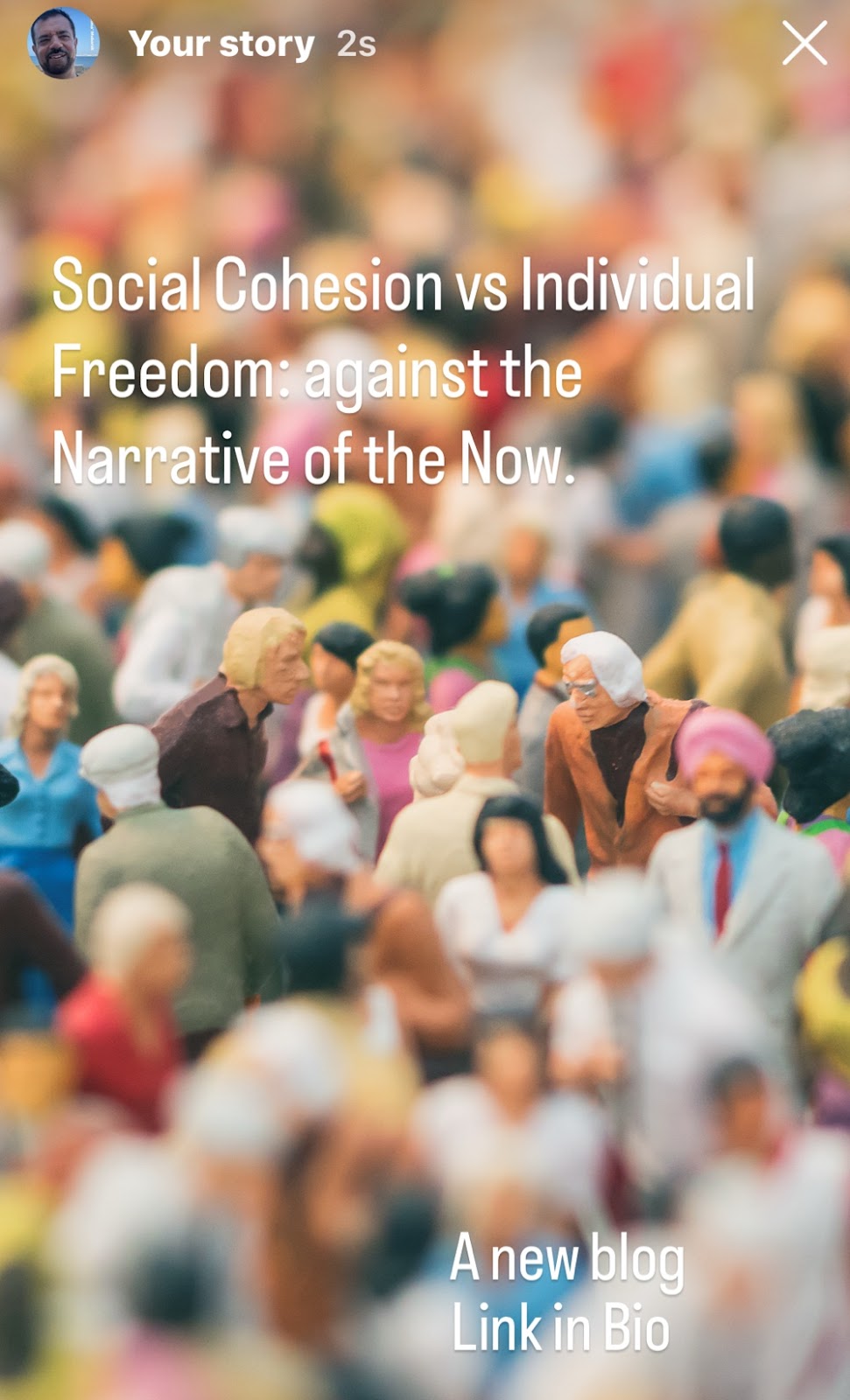
Indeed the Quranic narrative is quite the opposite, that people tend to want to obey authority, and it is that blind obeisance to authority that blinds them, each, to their own individual morality and culpability.
That man is first a moral creature, and then a social animal. For it is in the society of other men/ women that we find both the ability to do great good, but also far wider harm.
The Islamic mindset is revolutionary in more ways than one, and far deeper than what most assume.
For we believe in the natural goodness of man, that man wants to believe, do good, be industrious, and help others. That when men do those things then they find a satisfaction of soul that no other activity can bring. That man is purposeful, and is happiest when he/she finds their true purpose.
Whereas the first assumption that dominates Western thought, and even the books of our scholarly classes that have not the ability to question the given narrative, is that man is essentially evil. That left to himself, he seeks harm and is selfish, and has no regards for others. And so his individual freedom will always be at someone else's expense.
What is undeniable, even from within both outlooks, is that man is a social animal, that he thrives within the society of others. That people tend to want to gather together to form communities, the nuclei of which are families. That therefore when you think about it, our social cohesion is a given and never was under any threat, until that is "the narrative of the now" conjured that threat into existence.
A consequence of this social nature of man is that some individuals will be raised over others by virtue of their ability.
Where the two outlooks markedly differ is the nature of that authority.
Within the Western mindset, and the "narrative of the now" even amongst our own people, it is that authority commands authority, even that is when it claims to be people-centric, even then it is authoritarian in nature.
This circularity may seem pedantic, but it isn't, it is a very real occurence that we see all to clear in the hereditary nature of our one time kings and queens.
But in the Islamic worldview, all things have limits, and to pass beyond those limits is an oppression upon the very nature of things.
For within that schematic, our Messenger (saw) told us that the inheritors of the Prophets are none other than the knowledgable. And that none can compass ought of God's knowledge, save as He allows them.
It is epitomised in the following remembrances:
SubhanAllah, Glory be to God; how perfect His creation, the Cosmos and our World, how perfect He must be.
Alhamdolillah, All praise and thanks belong to God; the Provider and Sustainer of all.
La ila ha ilal Allah- There is no God save Allah; the One who answers the call of those who believe.
Allahu Akbar, Allah is Greater; The One beyond every Limit.
That authority by its very nature is limited, and to step beyond its limit is to visit oppression on those people whom it is charged with looking to and helping.
When we look at the Sunnah (the method) of our Messenger (saw), we see very real examples of him understanding his limits and acting according to them- and that in regards to the one with the greatest authority, vested with the greatest responsibility.
When we ignore those limits then we come upon the Quranic narrative against the Taghut, the oppressors whom we, naturally and unthinkingly, aid and abett in their oppression against our own selves and our own people.
That people are moral agents, and it is in the support of those who oppress us in the name of being people-centric, is solely an oppression that we visit upon our own souls, and our own moral wellbeing.
That authority when it is removed far from the people it is charged with helping, and every four years is a far distance, then it takes on a life of its own. And the people in blind deference to it, loose their own individual moral compasses in their support of it. Then expect oppression and wrong.
For truth and justice can only thrive when people as a collective stand up for it, and stand willingly against oppression.
And the Islamic paradigm is that the very nature of the Cosmos is moral, pointing towards the Infinitely Merciful, who created Hell as the greatest expression of His moral nature. That He wants man to do good, and His promise is true.
Therefore in the Islamic paradigm, our social fabric is not in need of protection by accepting the over-reach of the State, or any Political authority into our individual and even our communal lives.
What is at threat is our own moral wellbeing when we blindly accept that authority without scrutiny as to when it is of benefit, and when it over reaches into our communal, familial and individual lives.
Within that paradigm social good is enjoined through a collective that chooses to do so, this is Aal-ee-Imran 104.
That it springs forth from the collective, and is not imposed via authority from above.
So therefore in the Islamic Paradigm Political authority at the level of Nations is vested with not the internal life of our communities, but with protecting that internal life so that our communities can flourish.
So it's functions are and should be restricted to
1- War and Peace between other peoples and Nations.
2- Encouraging towards investing for the future as a means of protecting our Nation from the vagaries that our futures might hold.
3- The protection of our communities from internal enemies, that are organised and a threat.
4- The collection and administration of the Zakat, poor tax.
The Modern State that seeks to supplant community, and even family. That focuses on education and health and law, is not purvue of Political Authority within the Islamic Paradigm.
And for it we are the much freer.