Wednesday, 30 March 2022

Child Q and Abu Ghurayb on the streets of London

*If you have done nothing wrong, then you have nothing to hide*
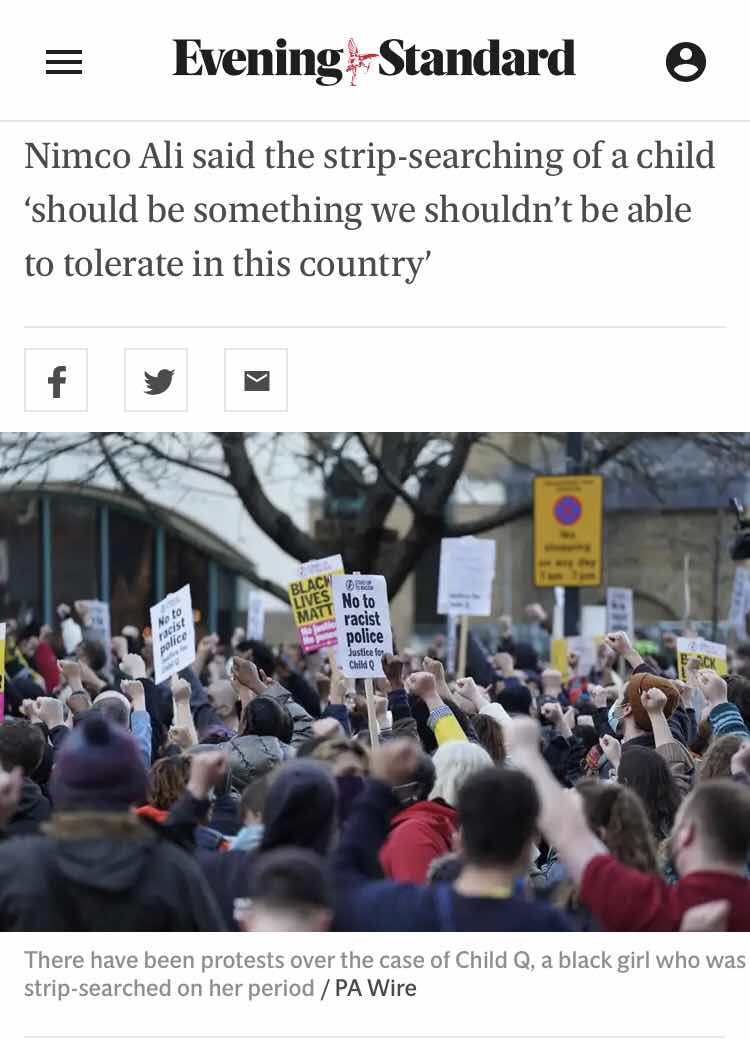


Recently I have fought with myself about how to talk with my youngest son in regards to the Metropolitan Police’s clear, and evident, not just racism but more worrying it’s complete disregard for human dignity.


My normal default position would have been “if you have done nothing wrong then you have nothing to hide” which implies complying with their every request. 

And that seems 100% reasonable. 


However what about when that complicity can become part of the crime, what then?


Child Q’s treatment within a space that she considered “safe” is a stark reminder of how backwards this society really is. 

If you are unaware of what happened to this 15 year old girl and how they stripped away her human dignity then there is a link to an appropriate news article, below.


In true Muslim society no such trespass would ever have occurred, accusations do not carry the weight of judgment, nor

retribution, and never should. 


It is clear that the “Presumption of Innocence” here in this society is a fallacy, and worse still that it is a bigoted one at that, where colour/ race/ and religion all play a part. And where yes if you are white and privileged, belonging to that class, then your innocence will be substantiated and not just presumed. 


It is also clear that the “Presumption of Innocence” as a fallacy actually permeates the whole of the Criminal Justice System. From the Police that presume guilt as a means of making “their case”, to the CPS that fail to hold them to account, to the jurors that focus on fear, and the negativity ingrained in their false morality and outrage. 


A false morality and outrage that takes it cue from our press, who so easily and readily stir the peoples’ emotions. 


At times, in our courts, this outrage is simply that the accused happened to be accused, and that therefore there must be good reason for it. That they cannot justify those reasons past the actual accusation is no matter, for justification is always an easy matter once the thing has been decided. 


Henry Fonda’s “Twelve Angry Men” is a great piece of fiction that even I love to watch and elude to as the way Justice should work. But that has been so clearly proved false by numerous miscarriages of justice where the jurors just get carried away with it all. 


A dumbing down of the process that those students of human interaction know only to well as “group-think” *1 


We know of so many clear, and obvious, miscarriages of justice and therefore how many are there that we can never know. 

The non-descript ones that have destroyed the lives of ordinary people like you and me. 


How many innocents languish in our jails because the Presumption of a Innocence just doesn’t work.

How many their families destroyed. Because the Police presumed guilt, and no one thought to question them or hold them to account. 


It should be replaced by something stronger than a presumption, that should permeate not just the end game where everyone has already really been “presumed” guilty. 


And it should be mirrored in the whole of the investigative processes, where at present any lead, in the investigation, that points to innocence are just plainly and fully ignored. 


It is clear that the Police care not, neither for truth, nor justice but for prosecution. And are governed by the same false morality that stirs the public realm. 


How much the better our way, and our society. 


For in Islamic Legal Theory the one making the accusation is required to bring proof, and the honour of the accused is sacrosanct, so that when it is brought into  disrepute by that accusation, then it cannot be saved except with due punishment. 


Here people are not “presumed” to be innocent, but people are in fact “innocent” and falsely accused unless proven otherwise. 


Indeed, the much, much greater harm is done to the fabric of society by the one that falsely accuses as a means of “revenge”, than when the accusation is well founded and proven true. 


In this society nothing happens to those that make an accusation that is not carried through to full retribution by the Criminal Justice System. 

Indeed the Conservatives, the party of law and order, decreed that they are still victims even when no lawful retribution can be lain at the door of those that they accused. That those they accused are never free, and were never innocent even from the outset. 


Then those accusers are above natural law, and are free to accuse and destroy other people’s lives to their own satisfaction. 


In Child Q’s case her very own teachers falsely accused her of cannabis possession, because of a “smell”. 


Nothing happened to them for they were “within” their rights. And how many others have accused just because of a dislike?


However what is much worse is the way that 15 year old Child Q was treated by the Metropolitan Police, for that shows the depravity of their morals. 

After all dislikes are common currency in a society that is fed them daily. 


That accusation was enough to taint her with guilt, which in all likelihood has lived with her past the accusation being proven false. Precisely because the Metropolitan Police made her compliant, and therefore “willing”, in their abuse of her. 


I will never allow my son to become complicit in a crime done against himself. 


So, I have told him that in such cases our essential human dignity is more important than our sinew, flesh and bones.


It is more important than wanting to be, or appear, “reasonable”. 


This does not mean disobedience, but rather non-compliance as a means of reminding the Police that they have no right to destroy our dignity. 


And that they may break our bones, tear at our sinew and body, out of revenge for not bending to their will, but that we will not comply nor obey them in anything that destroys our essential human dignity. 


And that we will then, after the fact, fight them mentally and without let up until they know who we are- 


That we are Muslim, the followers of Muhammed (saw), who never lost heart, and the fire of the religion of God burns deeply in our veins. 


 And they will find no fear in us for God says in the last verse of S Hajj:

وَاعْتَصِمُوا بِاللَّهِ هُوَ مَوْلَاكُمْ فَنِعْمَ الْمَوْلَىٰ وَنِعْمَ النَّصِيرُ


“and hold fast to Allah, for He is your Maula (Protector of the Believers), what an Excellent Maula (Protector) and what an Excellent Helper!”


And we will teach those that do not know. 

That we, Muslims, are intelligent and fearless, nor rash, neither will we grieve. 


END 


*1 where the IQ of the collective has been shown to drop down below the floor of the lowest individual IQ in the group. 

Saturday, 12 March 2022

RESOURCE- SALAAT and Wudoo presentation.

SALAAT- WUDOO PRESENTATION for use within a Mosque Setting. 


  • Messenger received revelation over 23 years.
  • Early obligation to pray 
  • The Quran states that the Whole World is a place of Sujood- prostration and so Muslims do not have to pray in a Mosque. They are obliged to pray and you may see them praying outside, because of that obligation. 
  • Manner of prayer and the times of prayer taught by Angel Gabriel. And therefore revealed mode of prayer, sent down and not man made. 
  • Messenger (saw) taught us how to pray. 
  • A master of pithy sayings: “Salah Miftahon Jannah, Wudoo miftahoon Salaat”: Prayer is the key to heaven, ritual purification is the key to the Prayer. 
  • His sayings differ substantially in style from the revealed Quran. 
  • Wudoo, ritual purification, described in the Quran. Get them to read translation of S. Maida verse 6. 
  • Demonstrate Wudoo with reference to Qur’an and show that the Sunnah explains it and clarifies it. 
  • Explain that Wudoo is an act of devotion, in a similar manner to Salaat being an act of devotion. It is a ritual. 
  • But Wudoo is also more than this, Muslims for example are advised make Wudoo before every major decision. It freshens then senses as you can feel the water touches all of your senses, and Allah in the Quran declares that He calls to life. 
  • So Islam is at core, conscious and deliberate submission. 
  • Rifadayn, the outstretched palms, at the start of Salaat symbolise this. 
  • Ask them who knows which way we face?
  • Ask, for the first 15 years of the Messengers mission does anyone know the direction of the Muslim prayer?
  • Get them to read translation of S Baqara v144. 
  • In Salaat we begin with al-Fathiha also known as Sab al Mathaani, the seven oft repeated. Explain why it’s called this. 
  • Ask if anyone knows the Lords Prayer and ask them to recite it. Explain that there is nothing problematic in the Lords Prayer since it talks about God and not the Trinity. 
  • Explain that Muslims believe that there was one message brought by all Prophets. 
  • That we believe that they were all Muslims in the operational sense, and so were the Hawareyoon- the term that we use to describe the twelve disciples of Jesus (as). 
  • We do not believe that Jesus (as) brought a new message from God. We further believe that he was raised to God and did not get crucified. And that on his return he will confirm the truth of Muhammed (saw) - the last Messenger sent from God with His greatest miracle - the Qur’an. 
  • The Qur’an is for Muslims the literal speech of God. That He has preserved through 1400 plus years. 
  • Then get them to read al Fathihah- the opening of the Quran- and it’s translation. 
  • Explain that Rab, the Lord Provider is similar in context to the Christian understanding of God, the Father- the Provider. 
  • Explain that the first verse of Fathihah is about thankfulness and that being thankful is the core to Happiness. 
  • Ask if anyone has visited a Muslim Country and how they found the people? Unlike the media impression Muslims are a happy people. 
  • Imagine finding something to be thankful for 27 times a day, when all you have is the shirt on your back. 
  • Next go through the structure of the Salaat exposing what we say. 
  • We stand in prayer, prostrate and sit. And it’s interesting that we sit when we send dua and supplication upon Muhammad (saw), the Messenger of God. 
  • He would not suffer for anyone to stand for him. He (saw) was many things, but he was not a King of Men. And foremost he was a teacher. 
  • The Quran was revealed over 23 years of his life and to understand it needs a contextual appreciation of his life. 
  • His life was well documented and he lived within the fullness of history.  
  • If you want to ask any questions then ask it of a Muslim and do not use the internet. You can always come to this Mosque. 

Sunday, 2 January 2022

A Reflection on Hypocrisy


A Reflection on Hypocrisy 


The moral code

The Moral Code of a Muslim can never be called into doubt, even despite us not having the equivalent of the Christian and Jewish “Ten Commandments”. 


And that we can see at the treaty of Aquabah, where the Medinese were bound to a moral code even before the emigration of the Messenger (saw) to their land. 


This moral code further developed past the emigration to include amongst other things the right of privacy, to the extent that when we are passing by a persons home, then we are advised to not look in, even that is if the invitation begs. 


And further developed to even include shame. That whilst truth is our highest endeavour, let not your ultimate search for it destroy that search for others by your muddying of the waters. So much so that shame trumps truth here.


Indeed the highest of our moral philosophy is the Prophetic ethic “want for your brother what you want for yourself”. 


Very early on Muslims were nuanced enough to know that that didn’t mean give to your brother what he wishes for himself, since the rights over property, and keeping and returning of trusts, are contained both within our scripture and were further emphasised at the farewell sermon, on the day of the Greater Hajj, in the penultimate year of the Prophet’s mission. 


That we each have a right to own property, and we each have a right towards the security of that property. 


Then the ethic is not about property but about improvement.


That we should each help others to improve their own lot, even that is when they might succeed and go beyond ourselves. And in the latter case, it is even more so incumbent on us, even as some of the Ansar were eclipsed by their Muhajir brothers. 


The going beyond is not just what we should expect, but what we should take heart in encouraging from the outset. 


And for those who lack the capacity then we should give to them security, by providing for them little but oftentimes. 

And incredibly these injunctions are contained within the sublime Quran. 


Thus it is that when we compare the two, our Moral Philosophy is shown to be more nuanced and comprehensive. 


And ours does not bend with the vagaries of time and circumstance, and what developing society might deem to be both valuable and true, now, and in the future.


A perfect society

Because at root the gift of Islam to Mankind, from God, is the creation of a justly balanced society, in tune with all the needs that man may need to find fulfilment with. 


That If other needs surface them they are superfluous, and only becoming evident because we neglect some deeper need that remained unfulfilled within us, because we neglected the truth of that society that we had been gifted. 


So much so that the vagaries and uncertainties that time might broach for other Nations, have no bearing on ours. 

For with ours the true religion is nothing except the true society, that it made clear, leaving nothing to doubt. 


So that what was forbidden then is forbidden for us now, and what was left untouched and not forbidden remains so to this day. 


Everything has been made clear. 

And that is one of the cornerstones of our belief. 


This finds resonance within the greatest of miracles that Mankind was also gifted with through, the last Messenger sent from God, Muhammed (saw): the Quran. 

In which the very first chapter, al Baqara, is concerned with just that: the blueprint for such a justly balanced society. 


And it is for that reason within the very first verses, of that very first chapter, of the Quran that we find the fullest description of hypocrisy. 


For hypocrisy finds its greater expression within society. 


The Hypocrisy 

What is clear when you deliberate upon the hypocrisy described within the Quran is that it is not as we often depict and understand it. 


Hypocrisy is when we show one face to one party and reserve another face for another party, and maybe even have a true face which we reveal to none. 

It is a hiding from openness. 


But what is striking about the similitude that God brings in describing hypocrisy is how blind the hypocrite is to their own hypocrisy. 


So that when some speech comes to wake them from it, they only thrust their fingers deeper within their ear holes only trying to drown out the sound. 


And when some knowledge comes to them they walk about in the light of it for a time, until the darkness re-surrounds them and they become just more blind. 


That the hypocrite is oblivious to his self-deception, oblivious to the harm that he causes and cannot see past his own nose. 


In the logic of our Hujjat-al-Islam, al-Ghazali, the hypocrite justifies his zulm (oppression) by bringing argument. 

Whereas the fasiq (wrongdoer) simply wrongs, but does not seek to justify it. 


So that the hypocrite deluded himself by way of argument into believing that he is doing the right thing, and is a bastion of good. Justification is always easier after the fact of your choice of which side to stand on. 


Just as in Baqara the mischief makers say by way of argument: “we only bring peace” for “we are the peace-makers”. Whereas the truth of that is that they only bring it for themselves to the exclusion and consummate destruction of others, for whom they care not. 


Maybe this is the reason why the names of the hypocrites was entrusted to the trustworthy amongst the Messenger’s Nation. Because the knowledge of it could neither benefit them, nor us. 


For our society is one fully open, and any stratification would further hinder the people, wholesale, in their ascent to closeness to God. 


We must accept them for who they are. 

That they are a part of our society and therefore all societies. 


And then that we must not listen to their argument, nor anything that they espouse. 

But not hinder them, in their descent, for it can never benefit those that cannot see past their own selves. 


The Reflection. 

The only thing that can save us from descending into the pit of the high walls of hypocrisy is self reflection. 


When we speak, do we, in the language of Nabi Isa, cast the first stone?


When we act, how would it be if another acted in a like manner against us?


Do we propagate that which is base, or that which elevates others too?


Do we set a rule up for others, and then in the same breath break it for ourselves?


These are some of the questions those that reflect, ponder to the benefit of their own souls. 


For it is the soul which is the most precious of entities. 


<<Surely the one who purifies it and allows it to grow in purity succeeds. 

And he who corrupts it has failed>>

S Shams (the Sun) v9-10


And then the understanding that the end of all things belong to God, whereas our every hope should be to remain true to principle, and truth itself. 


That our concerns should be the means. 

That we remain open to all, and true to our word. Nobility is not just our birth right, it is our way. 


For in essence we believe that God is the One that created each of us. 

And that He knows us better than we know our own selves. 


And He is the One in whom refuge should be sought. From our duplicity, from our belief in our right to things over others. 

And when you return to Him fully revealing yourself to Him in true supplication, then in that lies the solution of every hypocrisy. 


That God is the one to whom is your return, and there is no hiding from Him. 

And there is no escape from Him, except back to Him. 


Knowledge is sought through study and reflection. That is the reason that the knowledge that I peruse here is not quoted verbatim, but is for you to find for yourself and deliberate upon. 


END

Saturday, 4 December 2021

Like Sheep being blindly led

If the religion does not ennoble you, then you follow not it, but an invention or a parody of it. 


The Messenger (saw) choose Abu Bakr, but left the final decision up to the community of believers. 

For he said, “Let all doors to the Mosque be closed except the door of Abu Bakr”


One day after Fajr Salaat he (saw) shamed Abu Bakr (saw). 


For he asked “Which of you had visited a sick person today? which oh you has helped an old person today? ....” and it went on. *1


They all reacted in shock 

“O Messenger of God, it is only yet Fajr (the morning prayer)”. 


Abu Bakr (as) had. 


And the Messenger then explained that 

“He is the best amongst you, because he has the best heart”. 


How often do we elevate people because of the knowledge they claim to have?

How often do we disregard those of the better hearts?


The Messenger (saw) said that Islam is Yemeni, and by this he meant that it is consideration for others, kindness in manners, and all heart. 


The religion should soften your heart, make you more generous and giving, 

make you laugh more in order to cheer others, 

make you less harsh and stern. 

And by rights it should make you happy too. 


The Quran is God’s speech. 


And throughout it, and at it’s outset it asks for you to contemplate and think for yourself. For it is through that struggle that we can each become closer to God. 


This does not need for you to attend a University, or a School, or a Madrasa. 


How many of those who have exited from there well qualified, have contemplated?

How many of them learn by rote how to justify their own positions within society?

And without thinking do not reflect, nor think deeply. 


Often they will use Hadith that are clearly about social interaction, and remove them from their context in order to cement their authority. 


“A believer should leave alone what does not concern him.”


Means that you should not be nosy, and it is not yours to pry. And they take it out of context to say that believers are concerned with increasing their faith, and so you should leave off things that do not increase your faith. 


However innocuous sounding this may seem, this is  NOT THE SUNNAH. The religion is clear, and God wants people to be free to fully appreciate Him. 

We do not need to add anything to it, and should not subtract anything from it. 


“If you do not have anything good to say, then be silent.”


Once again a Hadith about social interaction, which they take out of context to say that if you have not studied in a Madrasa, or done an Alim course then you should be silent. 


How ignorant they are. 

How they do not reflect, nor even contemplate. 


Do they not know the reason that Muadh ibn Jabal (as) gave up Hadith Bitaka?

Nor of the Messenger’s (saw) command to the countless thousands at the Farewell Pilgrimage “those that are present tell those that are absent perchance they may better understand”. 


And who is it that better understands, except the one who contemplates and reflects?


That is the path towards God. 

To both reflect and contemplate. 


And that contemplation is an endeavour of a lifetime, accessible to everyone, and not just those who study in an institution, for a limited number of years to gain a qualification. 


And because of this God has blessed me, and I wish that blessing to be with you all too. 


For I have seen years past 

Jesus (as) in a true dream, and he was descending, stern of face. 

The Messenger of God (saw) thrice, the second he came towards me arms outstretched to hug me. 

And much more than that. 


And this because I contemplate. 

For this is, without doubt, open to you all. 


By all means learn from those who claim to know, but do not leave off from holding them to account, nor on reflecting on what they say and do. 

Take the best from them and leave off from the worst. 

And do not be as sheep, being blindly led. 

Open your eyes, and be alive. 

Sunday, 28 November 2021

Tooth for a tooth

“Tooth for a tooth. 

An eye for an eye. And a life for a life.”


This is the Mosaic Law, and yet in his youth Musa (as) [Moses] killed a man in anger and in defence of another. 

We should then contemplate his life, in the light of our revelation. 


The birth and subsequent protection of Musa (as) in the household of Pharaoh was indeed preparation for who he was destined to become. 


And yet the choices that he made, and that we make, are always our own and belong to us. It is what we take from them that defines who we are to become. 


When Musa (as) killed in anger one of the Egyptians in defence of one of Bani Israel, he knew that he had committed a hated crime and fled from the city. 


He was one of the household of Pharoah and we can see that he was clearly recognised as such on his return, out of the wilderness, to confront his step brother. 


We know that Pharoah’s wife was barren, and unable to conceive, and it is for this reason that his cries in the Ark drew her to him. And their bond was one of compassion and love. 


In so many like cases it is the Barakah of looking after, and loving, someone else’s child that brings the fruit of the womb to the normally barren woman. 


And so a son must have been born. 

It is this son, the heir of Pharoah, who himself then became Pharoah in his own stead, that Musa (as) was sent to confront. 


This is then his younger step brother. 


And this explains why Musa (as) was allowed an audience with Pharoah, and then the whole conversation of what took place between them, that we have clearly delineated in our own revelation. 


After fleeing from all of the strappings of power, that being of the Pharoah’s household meant, he went into the dessert. 


He must have been full of regret, and rightly so. And so he wandered in the dessert for long. 


We must then ask ourselves what is it that caused for God to look again with favour upon him?


For whilst it is clear that he was chosen to be the one to confront Pharoah and then lead the Children of Israel out of Egypt. 

God chooses His people because of the quality that He knows is latent within them. 


There is a circularity here that we find within the revelation itself, and it is apparent within the cosmos and our destinies that are written and yet to be fulfilled. 


That we each have a choice. 

That much is apparent even within the Seerah, which God calls the wisdom and that which He sent down alongside the revelation. What is the wisdom then, if it’s not how we seek to interpret the greater book of our lives? And those who are best, are those with the best interpretation. 


So what is this latent quality that we find within the life of Musa (as) for which God forgave him and then raised him as one of the five greatest Prophets sent to mankind. 


We know the story of how he came to a well, and there helped two unwed sisters to the water. How he came to their father, and how the father contracted for him to work for him for a number of years after which he would wed one of his daughters to him. 


Here we find the quality of Musa (as), for he fulfilled the contract and then some too. That is that he went further than what was asked from him. 


The Messenger of God (saw) was known as al-Amin, the trustworthy, before revelation descended upon him. 


Our religion is unique in its appreciation of the importance of keeping trusts and contracts, so much so that even our marriages are at core simply a contract between a man and a woman. 

And when we enter into a treaty of Peace with an adversary we will not break the treaty even when we suspect foul play. 

For that is not our way. 


I recall a former member of staff of mine who in his year of contractual employment with me took his Hajj. I impressed on him the need to fulfil the contract he had with me, but he thought the religion more important than the contract he had entered into Little did he understand the importance of fulfilling your contract, for he left on bad terms probably feeling hard done by. 


That the religion is for us, and for our benefit. But when you enter into a contract with another, you fulfil your trust first and then look after your fardh next. 


This may sound controversial to most. 


But ponder then the story of Musa (as) and what turned God to favour him, if it was not in his scrupulously fulfilling his contract. 


These are my opinions and I write to stimulate for you to contemplate and think. 


For knowledge is sought through study and contemplation. 

Not lectures and talks, nor this above.