Wednesday, 15 April 2020

The Inquisitive Strangers

The creative mind finds inspiration in those things that others see as normal. 


As the management guru John Adair states, creativity is about “finding” the strange in the normal, and making the “strange” normal.

In S. Baqara God teaches Adam (as) the words and proceeds to ask him to name them. In the exchange we have there between the angels and the Most Gracious it’s clear that something special is being imparted to Adam. 
Something that will make him stand apart. 

From the first fire, to the first wheel, it’s clear that man has a burst of creative energy, and an innate curiosity, that caused Adam (as) to be sent down. 

In Christian theology this is The Fall, but in the Muslim text it reads as “anzala” - sent down- which is also used for the descent of revelation from on high, and for life giving pure water from the rain clouds above. 

As Adam (as) argued when Musa (as) [Moses of the Old Testament] confronted him, all had been written from before. (Please search for the Hadith). 

Aisha (as), the mother of the believers, when asked about the Messenger (saw) said that he was the living Quran.  

Indeed the Quran as a book of instruction takes on another life when we consider it in the light of the Seerah of the Messenger (saw) [his biography, life, actions, methods and sayings]. 

Whilst the scholars argued in the past about whether the Sunnah (the way of the Messenger) could abrogate the Mushaf (scriptures) that question becomes a moot point when you consider the revelation of the latter part of v3 of S Maida (chapter 5). 

Imam Shafee (rm) was of the considered opinion that it could. 

But another way of looking at the link between the Messenger (saw) and the Mushaf is in the words that they each used. 

A big part of Tafseer of the Quran (seeking to understand it) is with the Quranic text itself- not just the linguistic aspects of each part of text, but what another part of text can tell us in the light of the first part. It is as if the Most Gracious has spread knowledge throughout it as a means of making us search through it. And the very act of flicking through the pages and searching our memory is generative of understanding. 

If we consider as we should that the Mushaff framed the words of the Messenger (saw) then our search should extend beyond the Mushaff and into his Seerah (biography), the Sunnah (his way and method) and his Hadith (sayings and words). 

The Messenger (saw) famously said 
“Islam came as a Stranger, and will return as a Stranger, so give good tidings to the Strangers” (narrated by Abu Hurayrah). 

Traditionally this has been taken to mean that when Islam first appeared there were few who followed it, and it will return back to that state of a few following it.  

But when we read S Qaf (50) we see a different use of the word Ajeeb- strange. And the Quran affirms that it is a strange thing that the Most Gracious should send a Messenger, and that we should believe that when our bones and flesh have become dust that they should be reformed and made anew. 

But no less strange and wonderful are the skies and heavens, the earth and our place within it. And the Quran and it’s manifest unusualness. 

Indeed our religion is one that needs to be constantly rediscovered by each of us. Contemplated on, and found to be both wonderful and strange. 

Then give good tidings to those strangers, who contemplate the Qur’an, the life of the Messenger (saw) and what he brought and their own lives, as they unfold, in the light of that knowledge. 

For it is for them that Islam constantly returns with answers. 

What I have said here is my considered opinion, and it may be wrong; may we all be guided. 

Knowledge is sought through study and contemplation, not through lectures, nor speeches nor this above. 

Friday, 3 April 2020

the first struggle and the forgotten ijtihad

Last time I wrote about the tension within Islam that keeps it a balanced religion. 

This found expression very early on, even before the first public command to invite to the good, with the clause;

“Surely with difficulty comes ease. 
Surely with difficulty comes ease.”
(Surah Inshirah- the expansion);

that preempted the mission of the Messenger (saw), but also tells us all of a general rule. And probably it is for that reason that it was repeated twice, to emphasise it’s generality. 

That it is not wrong to seek ease, but that the true path to it lies through difficulty. That to be true and hold to a principle may present you with difficulties, but steady yourself and remember the reason that you do so- it’s not because of the ease that follows- but because it is the right thing to do. 


Islam means Peace, but it’s a special type of peace that is attained through struggle. 

And whilst it is common currency amongst Muslims to believe that the greater struggle, that is talked of here, concerns the struggle against the lower self (nafs) of desire, this does not find resonance within our scriptures. 

Islam at outset has always been a physical struggle, that finds expression in our greatest worship- the Hajj- which is in essence a walk, and rites performed in their correct order and at the right times. 

And just so, the first revelation in regards to Jihad, or struggle, we find in Surah Furqan- the Criterion (between right and wrong);

“So obey them not, rather struggle against them with it; (that is) a great struggle”  verse 52; 

which was sent down before the establishment of the Muslim polity, and before fighting against injustice was enjoined upon us. 

Here we can clearly see a command and an inference that to be silent against people, who do wrong by denying the message or the Messenger (saw), is to obey them. 

The Quranic injunction here stops short of civil disobedience. 

The conundrums of this verse are several. 

First- it appears in S. Furqan in which God declares that He sent down the criterion (between good and bad, right and wrong) and so you might reasonably expect a rule or a command to be delineated here. In the whole of Furqan this is the only verse that could be interpreted as a command. 

Second- the pronoun “it” in this verse is usually translated as the Quran itself. 
This seems entirely reasonable but breaks a logical rule that many commentators often pay heed to- that “it” normally should refer to the thing that precedes the “it”. 
Therefore, we should at least see if following this rule, here, generates a different meaning?

Third- what is the “a great struggle” referring to? 
In the above translation I had inserted “(that is)” before “a great struggle”, to make the verse more readable. 

What is clear, here, is that the struggle mentioned here is not a struggle against self. The obvious answer is the struggle against the arguments of the disbelievers. However due to the ambiguity that is lent by the missing (that is) we owe it to ourselves to consider if it could also refer to something else?

Might it also be a self referential sentence? For one unusual characteristic of the Quran is the amount of verses in it that refer to itself. 

Fourth- the verse when we look at it in it’s bare bones is cryptic and disjointed, when it could have been clarified. 
Was it therefore left cryptic for a reason?

We know from the Seerah of the Messenger (saw) that the companions at that time hoarded the Qur’an like it was gold dust... and during the persecution that was meted out to them in Mecca it was a light in a dark place. 

And there they were known to commit 5-10 verses of it, into their personalities, before moving to the next 5-10 verses. 

In their own words they said that they implemented those few before moving to the next few. And they were known as the Quranic generation, that were moulded by it’s direct revelation that concerned them all deeply. 

The conundrum that that presents us with, now, is that we know that practically all of the implementation, of all that is Islam “now”, occurred in Medina after this fact. 

So what and how were they implementing, when there was so little to implement, there in Mecca?

There was a time when the believers knew the mother of all sciences to be the Qur’an and our struggle with trying to understand it, that is called tafseer. 

And that Allah t’ala revealed both it and the wisdom. The Seerah is key to understanding the Quran, where they should both be read and struggled with together. 

I write here to stimulate thought and to cause you to see that the Quran is not the purview of the Scholars, for if that were the case then woe unto us who have become like the First Nation that are rebuked in the Quran. For they left the knowledge to the Pharisee and their scribes. 

I have my considered opinions on the above verse and I have chosen to leave them unexpressed here, so that you might have cause to deliberate yourself. 

The Quran has always been an open book and Muttuwatta- known to everyone- accessible and available to everyone. And it’s study should not be left to a class of people, but should belong to all of the people. 

This is the forgotten ijitihad, which no less needs checks, and balances, in its approach so that those that try do not fall into error. 

The like of which I have done in writing here. 

InshaAllah both myself and Ahmed Rawi are committed to bringing together a group of brothers who will benefit from the study of the Quran in the light of the Seerah of the Messenger (saw). And we will act as checks and balances one for another. 

What I have said here is my considered opinion, and it may be wrong; may we all be guided. 

Knowledge is sought through study and contemplation, not through lectures, nor speeches nor this above. 

Friday, 20 March 2020

Fatalism

Fatalism has not always been alien to Muslims. A sect called the Jibirites believed that everything was “compulsion” and that freewill was an illusion. 


Their belief was roundly rejected and relegated to the textbooks of our history. 

For we have always believed, from the first, in the ability to effect change. 
And it is this that is so dramatically demonstrated in our common history, and the history of the World and our place within it. 

Indeed it is our unique belief that spurs us to seek, and effect change for the better. 

When we juxtaposition free will with qadr’Allah (predestination, that the pen has written and ink has dried), we find no contradiction there when we seek to understand them on the basis of the effect that they should have on each of us. 

There is no free will without responsibility (no soul shall be given to bear a burden greater than its capabilities- al Quran), and qadr’Allah simply frees us from the burdens of our past. That our pasts cannot determine our future and present selfs, it is our choices that do that. 

A true saying of the Messenger (saw) informs us that if all the World’s men and Jinn gathered together in a single place to harm you, then none could save except as the Most Gracious wills. 
That is qadr’Allah. 

And that is the fearlessness incumbent on one who truly believes, which is tempered by our understanding in the true nobility and universality of the religion. 

That your success and your failure, your living and your dying, is ultimately because the Most Gracious willed it so. 
And to fail by His hand is no lesser an achievement than to succeed by His leave, and sometimes even more so. 

That we are not afraid of fear itself, that the risk of failure cannot curb our drive to succeed and try again, and keep on trying. 

Indeed God’s words are true and cannot be doubted, just as His promise is true and only a fool would doubt them. 

And yet on another level it is as if both Hell and Heaven were created as a boon, and a blessing, for us- that He wishes for us the best and truest of conducts- so that we might fear the impeding judgment and be both true and just, even when it is against ourselves or even our people. 
And maybe that is why they are mentioned in ar-Rahman. 

They are our spur to be true, and just amongst others. And for that we should be very grateful. 

And a man never spoke truer who asked, “O God, save me from the Hellfire which is true, and enter me into the Garden of Paradise, which is true. “

And it is this that causes Islam to stand out as being no ideology; no simple idea that drags men to the extremes of behaviour; because we are always balanced between two. 

(The fear of )Hell and (the desire for) Heaven. 
Freedom and Responsibility. 
Ability and the acceptance of our ultimate inability. 

For from the very start we are forced to be balanced between two poles. 
The declaration of faith is fIrst denial and then affirmation, an affirmation which of and by itself is not belief. 

Declaring that Allah exists, is of and by itself not faith, for this was the affirmation of the pagan Arabs, descendants of Ismail, before the coming of the Messenger. 

And “there is no other god”, or “there are no gods” is at first a declaration of our ability, that there are no deities whose reciprocity we have to appeal to- that we are both able, capable and free. 

And then once you have freed yourself from the myriad false deities that cloud the psyche of man, then to recognise, in earnest,  the complexity and intricacy of the Universe and our place within it- to begin to truly appreciate the majesty of the Most Gracious. 

A marvelling that can only lead to an abandonment that marks the beginning of peace within Islam. 

So even at first there is this tension within our very declaration of faith, that points to both our ability and capability and then to our abandonment in the realisation of the actuality that we are ultimately unable - unless the Most Gracious helps us. 

Finding culmination in our six beliefs, of which qadr’Allah is the pinnacle. 

Which does not make us fatalists. 
Contrarily it makes us champions. 

Being cogent, responsible and able - and then they seek only His smile, that He might boast in that high company about them. Because they know full well the risks and are willing to abandon themselves to them in His care whilst taking every conceivable precaution. 

They are the ones that hate the status quo. 

They are the ones who will leave no stone unturned in the search for a better World. 

They are the ones who show that it can be done. 

And these could even be our doctors, nurses, pharmacists, dentists, counter assistants and concerned neighbours that would daily brave our hospitals and our streets.

Friday, 28 February 2020

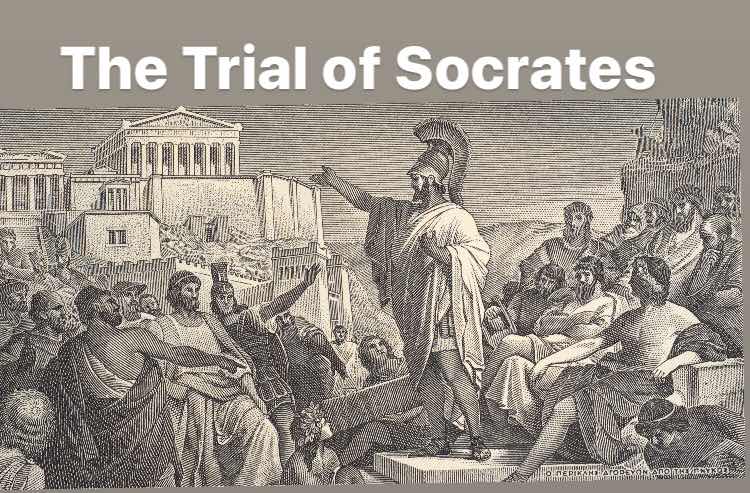
The Trial of Socrates; The Society that we aspire to.

When Socrates was brought before the Athenian assembly and charged with the crime of corrupting the youth, the charge that he was really convicted of was that of not doing “politics”. 


Contrarily he had given his life in service to the community; in his own words he had advised them, each and all, and on more than one occasion to pay heed to their moral and ethical wellbeing over their gaining an unfair advantage- one over another. 

He had taken this course contrary to his own apparent wellbeing, because he perceived a greater good in it and stayed that course beyond the judgment of death that was enforced on him. 

Solon said that a fortunate man is one who dies happy. Socrates died happy. 

Society often persecutes the one who seeks the good of the community whilst avoiding a political mindset; one who does not massage egos, and doesn’t work through cliques of people; being open instead to all, and one, and gives himself in the service of all, and not just the few. 

This is what we witnessed when Corbyn failed in the election. It was not a failure of vision, rather it was too much vision for too many people. 
It was a failure in “politics”, that he was not politic enough or rather more telling, that politics had not grown past the days of Socrates.

But it had, and it can again. 
Because that is not the society that we, as Muslims, aspire to. The society that we aspire to, was one that the Messenger (saw) moulded. 

Imagine if you will a society that safeguarded even the Munafiq- those that professed belief only to gain an advantage (the hypocrites who we know will be assigned the the lowest part of hell). Where their names were recorded and yet kept safe from common knowledge, to the extent that when they died the believers gathered to pray over them. 

Read the expedition of Tabuk. 
Where Kab bin Malik (ra) remained behind, and was of those who back slide. 

How the Messenger (saw) and the believers imposed a boycott on him. Not so much as a punishment, but more so that revelation might come down concerning him. *1
And the delight that they had, and the wish that he might be exonerated by Divine writ, when it happened and that heartfelt openness of a community as one. 

For whilst the hypocrites came and made their usual excuses, and were not hindered from doing so.. it was for the believers both a trial and an exposition of what should and could be. 

That even Wahshi who slew Hamza (ra), the beloved uncle of the Messenger (saw) was accepted into the fold and granted forgiveness.  *2

That is the openness that Islam ushered in to the human experience. *3
And that example will stand the test of time. 
  
What I have said here is my considered opinion. If it is wrong then that wrong belongs to me. 
Knowledge is sought through study and contemplation, not via lectures, nor speeches, nor this above. 
*1 the Messenger (saw) said of him that if he had asked me, then I would have prayed for forgiveness for him. 
However the community of believers, there, ever sought connection to God’s Grace, and Kab wished to be exonerated by God Himself. 

And it’s also clear that the Messenger also so wished it, and fervently prayed that revelation might descend exonerating him. 

Read the verses revealed concerning him. 

*2 Wahshi took the Shahadah with the
Messenger (saw), and was asked that he not present himself before him again as the pain of recollection was too great for him (the Messenger (saw)) to bear. 

*3 A benchmark of Sunni Muslim Civilisation is and was the extent to which we would go to to preserve that openness. 

The Seljuk Turk princes would ride out to open plains and remain there until the sun set, free from their cumbersome courtiers, in order to allow complainants full access to them - and none would be hindered from approach. 

Friday, 14 February 2020

the BasmaAllah

As Abu Bakr (ra) walked beside the mounted young captain, Usama bin Zayd (ra), leading his army to meet the Roman battalions that threatened from the North, he offered him advice. 

He did not tell him how to meet the Romans, neither the configuration nor the tactics that he should employ. 

He did not, at least not at first, remind him of the rules of engagement neither to chop the tree, nor to harm the peasant farmers, nor the old, infirm or young. 

His first advice was the most telling. 

For the battle worn companions in the train behind them marvelled at such a sight. 

The older, wiser veteran of many campaigns, Abu Bakr (ra), wanted to impress on the men that followed the necessity of discipline, and so he refused Usamah’s offer of his mount. 

And then the first rightly guided Caliph, the then leader of the Muslims, advised the young captain to remember the BasmaAllah. 

“Remember when you eat to say the BasmaAllah “- in the name of Allah, the true name of God, the Most Gracious, the Most Merciful. 

At one and the same time a dedication, a means and a way of partaking by His leave and through His grace, and then a remembrance of that grace. 

Indeed it is Islam that advocates a systems approach to living life to its fullest. 

And whilst it is vogue in today’s modern world to recognise the utility that a systems approach brings to work, it is less so for the things that are the more important. 

For the modern world advocates a lasse faire- everything and anything goes- approach to our personal and interpersonal lives and to our spiritual side. 

That your children should be the concern of the state, that your marriage doesn’t need time, nor work, that your faith is inconsequential. 
And that you are free in your social life to do as you please. 

And yet it is our Islam that advocates a systematic approach to all those things, as being in fact just as important, if not more so. 

That there is a right way to do those things. And therefore that there are better and also worse ways to do them. 

That your children will need your continual guidance, even that is when they are all grown up. 

That your parents have a right over your company, and friendship. 

That some times it is enough just to be there for your loved ones. 

And that in our social conversations we need to be aware of the hurt we can cause, or the alienation that can surface when we are not fully open to others. 

And it is the BasmaAllah that should remind us of all those things, precisely because it is the right way to start any, and all things. 

Remembering God, that He blessed us with the ability to try and achieve, to do and to fail, to learn and then go on. 

That the right way to start to eat, is to do so recognising that it is by God’s leave and grace that you partake of it’s nourishment.

And the right things to eat are wholesome foods, and these are those that are halal. 

And the right way to finish eating is by Thanking God for His provision and care. 

Alhamdolillah, Allah and his Messenger (saw) have taught us gratitude, even for the simple things in life. 
Like the clean and pure water that we sip, fully savouring it’s taste and eschew the thirsty gulp of an ingrate - even that is when we are thirsty. 

And it is this ever present gratitude, even when we have little, that makes us both happy, and contented, and is our strength in adversity. 

What I have said here is my considered opinion. If it is wrong then that wrong belongs to me. 
Knowledge is sought through study and contemplation, not via lectures, nor speeches, nor this above.  Knowledge is sought through study and contemplation, not via lectures, nor speeches, nor this above. 

Friday, 17 January 2020

the Invisible

The invisible 


“There is more than what can be seen.”

This is the cornerstone of our belief, and the third verse of al-Baqara that we believe in the unseen. 


Our belief goes further than that, for we believe that the unseen is far, far, greater than all that can be seen. 


Indeed it is a poor man who does not feel the connection with the Most Gracious, who is at at one and the same time the God of all, and the God of each. 


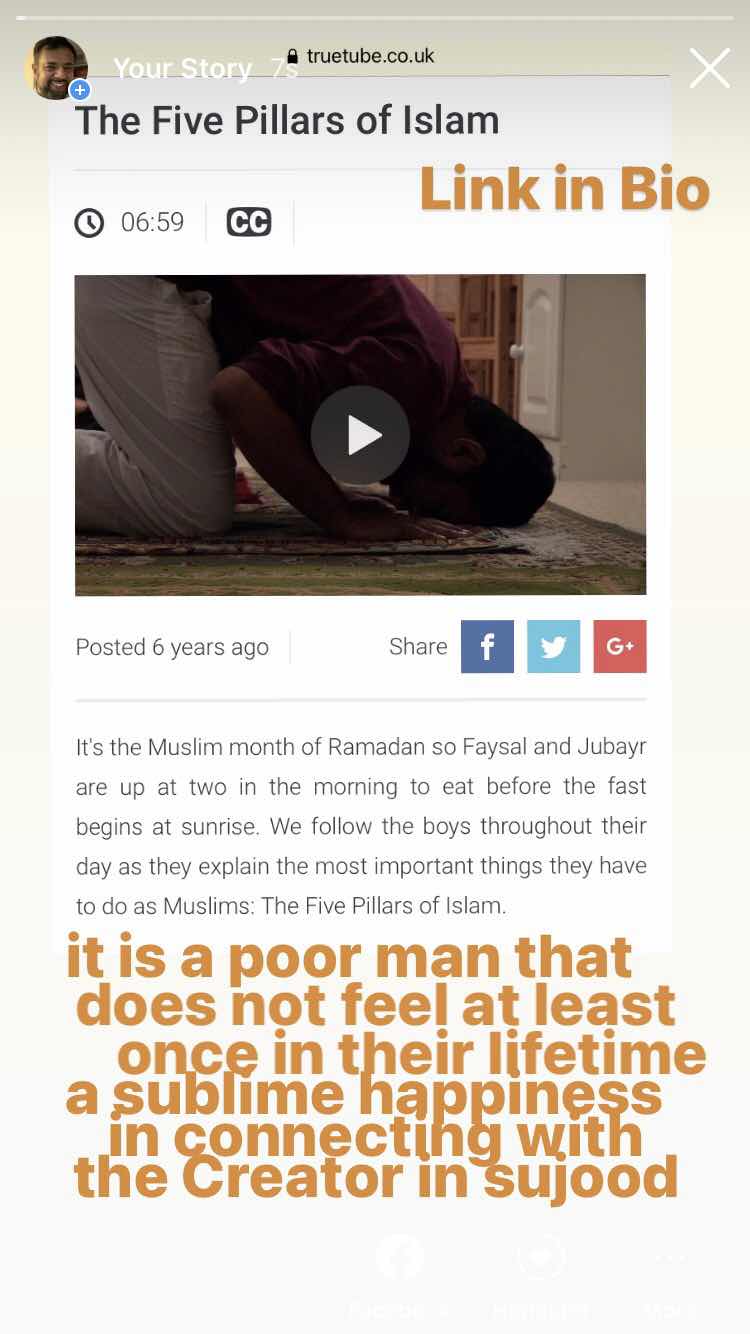
It is indeed a poor man who can not submit himself to the infinitely merciful, creator of all. Who does not know how to pray, and does not feel, at least once within their lifetime, the sublime happiness within prayer.


Indeed it is a poor man that gets lost in the minutiae of his small life. Who does not, and cannot, contemplate on the vastness, and intricateness of our World, and the consummate smallness of our common place within it.


Indeed it is a poor man that runs away from the richness of faith, because he believes that he cannot do justice to what he sees in the religion as intricate, and complicated, requirements and dues. He runs because he lacks faith in God’s good grace and knows not the Hadith Qudsi in which God says “whoever comes to me walking, I will come to them running” *1


Within prayer I ask at times, “O Allah bless me that I might be amongst those that praise you, and my children too.“

I affirm the reality of hell, even though I cannot see it and ask that I be saved from it. And I affirm the reality of heaven, even though I cannot see it, and ask that I be entered into it. 


And it does not make me arrogant, rather the realisation of these things that are far greater than me, humbled me. That my fate is not mine own to decide. 


That we believe in the hidden greater realm does not make us any less rational. For the verse that precedes that third acts as a spur towards the removal of doubt, by stating that it is (from) a book (the Qur’an) without doubt. 


There are two mechanism towards that end, the removal of doubt, the first is experience and the second is reason.


That the Qur’an challenges us to use our rational minds at the very first, with its above statement, and then later redoubles that challenge in a verse that directly mentions it, is of major consequence. *2


Succinctly then that same third verse, that we are concerned with, provides a formula for the attainment and actual realisation of glimpses of the hidden greater realm, that abounds around us:


“Who establish the prayer and spend (on others) out of what we have given to them”


To enter into Islam is in to enter into this, and it is an experience that is the most telling and cannot be known except through that experience. 

“Verily this religion is firmly solid, so study its depths (or enter into it) with gentleness”. 


The best gift that you can give to any man Is the gift of prayer, out of gratitude, that you make it conducive for others to submit themselves in prayer to the Most Gracious. That you establish the prayer in yourself, and help to establish it in others whose life yours touches. 


And then when you make not yourself the centre of your World, but you make the fulfilment of the needs of others the centre of you. 


Then the door unlatches, and you see and experience glimpses of things that are not of this World. 


The salutations of peace from the Angels when your heart is troubled, or the smell of flowers en route to the mosque in an alleyway, where there are none, or even a true dream.  


But the best of it is when you surrender yourself in the prostration of the prayer, and feel awash with the harmony of true self-effacement, and an involuntary smile lights your face. 


What I have said here is my considered opinion. If it is wrong then that wrong belongs to me. 

Knowledge is sought through study and contemplation, not via lectures, nor speeches, nor this above. 


END

*1 Abu Dharr reported: The Messenger of Allah, peace and blessings be upon him, said, “Allah Almighty says: Whoever comes with a good deed will have the reward of ten like it and even more. Whoever comes with an evil deed will be recompensed for one evil deed like it or he will be forgiven. Whoever draws close to me by the length of a hand, I will draw close to him by the length of an arm. Whoever draws close to me the by length of an arm, I will draw close to him by the length of a fathom. Whoever comes to me walking, I will come to him running. Whoever meets me with enough sins to fill the earth, not associating any idols with me, I will meet him with as much forgiveness.” Collection of the sayings of the Messenger, Muslim. 


*2“And if ye are in doubt as to what We have revealed from time to time to Our servant, then produce a Sura (chapter of the Quran) like thereunto; and call your witnesses or helpers (If there are any) besides Allah, if your (doubts) are true.” V23 Baqara. 

Friday, 3 January 2020

Exploitation and Freedom

Exploitation and Freedom


When we look at the mantra that governs the Conservative Party, or the Republicans, and not what they advertise about themselves but who they actually are...


You would be hard pressed not to find the following unsaid motor...


“Exploitation is necessary to create growth”


Or even 


“Exploitation is a necessary evil “. 


This meme has rooted itself within our thought pathways so completely, so much so that we fail to recognise both its pre-eminence, and then also fail to challenge it.  


To question its validity and the validity of it’s argument is not difficult, but what is difficult is to see its dire effects on us each individually and as a people. 


It’s claim to validity lays on its reversal, that “Growth or Wealth are created when someone, who matters little, is exploited.”


Now that it’s stripped of its disguise maybe we can appreciate its true worth. That it’s true that when someone is exploited, the exploiter gains innumerably and often very quickly, but at what cost. And does the gain justify the cost. But also when reversed the argument doesn’t logically hold; X=>Y, doesn’t necessarily mean that Y=>X. 


That whilst exploration leads necessarily to prosperity for the exploiter, that it does not hold that the only means towards prosperity is through exploitation. 


Indeed there are other more wholesome ways to ensure prosperity, not for the few- but for all. And it is Adam Smith in his magnum opus “The Wealth of Nations” who argued in that vein, that true wealth is created by open and free trade. Exploitation is neither open nor free. 


When Nations are free of exploitation, each Nation in its turn will progress more fully in what it does best. And the free movement of myriad goods and services will make us all wealthier, precisely because each will be that much more affordable (less costly). 


We should be in no doubt that the mantra that sustains exploitation and oppression throughout our World, is not there to make us all more prosperous. 


It is there to keep the few that prosper at the expense of the many. 


It is not about freedom, nor is about democracy, nor is it about anything good. 


It is this mantra that sees India and China tagged as great Powers, even when they cannot or will not provide for their own citizenry. It is the very fact that they are ready to exploit others, even if it is their own people, that makes our Politicians and Media call them “powerhouses” or the “Worlds biggest Democracy”. Both of which they are not, and both of which they wouldn’t be without exploitation.  


In the last couple of days we have each given and been given wishes of future prosperity by our fellow countrymen:

“May the New Year bring you prosperity”. 


The Conservative Party is viewed as being the Party of Aspiration by the vast majority of our countrymen. 


That the country does not aspire to honesty, nor to truth, nor to helping one another is a damning realisation. 

That they accept and aspire to exploitation is another damning realisation. 


That we must challenge those assumptions that allow and encourage exploitation is a must. 


We need, all of us to remember, how fully against exploitative behaviour our religion is. 


And for that it is enough for us to remember the words of the Messenger (saw):


“Do not intercept goods before they reach the market.” (Narrated by Imam Ahmed). 


Even in that most simplest of aspects, we are not to hinder men nor women from gaining their true worth. 


Knowledge is sought through study and contemplation. Not lectures, nor talks, nor this above.