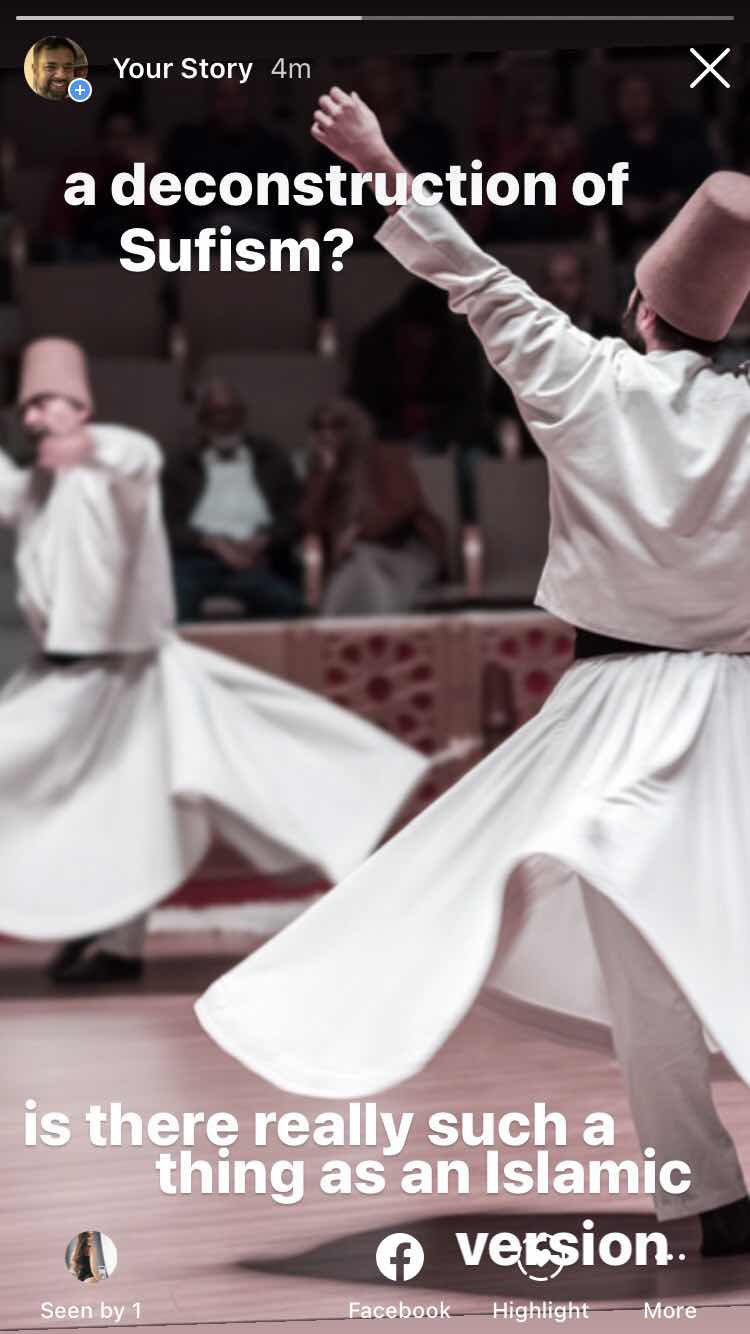
Friday, 28 September 2012

Heaven and Earth

Heaven & Earth.

A LOSS?


In the last post I argued that many religious Muslims have difficulty with the loss of the revelationary link between Heaven and Earth. This finality, in a long and ancient history of Messengers, and Prophets, from GOD, occurred when the final Messenger sent to ALL Mankind, Muhammad (saw), left us.


And it is their incapability to deal with that loss that causes them to suppose the continued revelationary and/or spiritual succession of Muhammad (saw), either through his family (our Shia brothers) or through his dear ones (our Sufi brothers).*1


*1[The way in which our cousin brothers of the Christian Faith deal with the same problem is through the supposition of a ephemeral entity called the Holy Ghost and/or through the divinement of the society of their Church.]


However the message that Muhammad (saw) brought, whilst affirming all that came before it, revolutionized our understanding of the relationship and link between Heaven and Earth.


Heaven v/s Earth.

For in OUR prior Judeo-Christian Heritage we find that Heaven and Earth were divided, separate and disparate. The antonym for Heaven, there, is almost Earth. For in Christian fiction Hell lies below our plane of existence, at the very centre of our sphere.


There also we find that Adam (as) FELL to Earth, whereas in the Qur'an Adam (as) was sent down to Earth (anzalna, which is also used to denote the descent of the Angels, Revelation and even life giving rain). Both traditions agree on whence he came, Eden or Aeden is in the Heavens above, but the manner of his descent is relevant.


From Heaven, being the abode of the divine, Adam (as) fell to Earth, being the place of mundane.


Heaven is perfection, whilst the lot of those on Earth is decay and loss. Heaven is bliss, whilst Earth is all toil and hardship. Heaven is the place of those whom GOD loves, the elect company of near ones. And Earth is the place of the rebellious ones who do wrong.


Thus was the speech of the high company of Angels when they were told of the creation of Adam (as), "Will YOU, O GOD, create one who will wreck mischief and shed blood on Earth, Whilst we do glorify YOUR every praise (in Heaven)?" (TMQ S2 paraphrased).


And it is for this reason that all religions see religiosity as being other-Worldly, Heavenly.


Whilst Muslims acknowledge the primacy of the World to come, they are however forbidden from seeking to escape from the here and now of Our World, with all of its mess/ uncertainty and guaranteed loss (S. Asr).


For them Monasticism, or any other like phenomena, has been expressly forbidden through a Prophetic Hadith, and this is even whilst our Prophet (saw) acknowledged that GOD loves such people. (There is no contradiction here, because the fare of the Muslim is different from the fare of all other Nations).


Life as Struggle.

Muslims know that what GOD intended was for Life to be a Struggle. For when Adam and Bibi Hawa (Lady Eve) (as) were sent down, Allah t’ala decreed “And let there be enmity (hardship/ friction) amongst/between you” (S2). The you here refers as it were to the whole of Mankind. 


And so by extension if Life is easy then you are not living; truly not living.


Life is Struggle and full of movement. And in all that flux Muslims seek to keep their heads firmly fixed to their bodies lest they fall. Five times a day their hopes go heavenward, five times a day their eyes return homeward.


And so a Muslim is almost like a ballet dancer or dervish that spins and spins, and who in order to prevent himself falling keeps his head (and eyes) firmly fixed on one of two points... snap, snap, snap; between 2 points at two extremes.


To see the Spiritual.

Snap, snap, snap.....between the Spiritual and the Mundane.


Until with gathering speed, the two merge in his eyes... and he finds the Spiritual in the Mundane.


And so after those 5 appointed times, and after having been reminded of the true reality that awaits him, our hero seeks his livelihood on this, his, temporary home (Earth). And Muhammad (saw) on seeing a man working hard with his hands said of him “ALLAH t’ala (GOD, Most High) loves those hands.”


The Heavenly and the Mundane.

This understanding that the Heavenly can be found in the Mundane, is something that Muhammad (saw) brought. For whilst Nabi Isa (Jesus the son of Maryam)(as= may GOD be pleased with him) asked his haweri-oon (disciples) to renounce the World, Muhammad (saw) asked his followers to embrace the World and when the time comes, to embrace the Next. To embrace this World fully and in it’s entireity, but not to love it. To own wealth, but to not let it own you. To act responsibly and then to learn to have faith and trust in GOD, leaving all things to HIM (who creates and then fulfils).


For Muhammad (saw) said “Tie your camel first (to prevent it running away) and then have faith” and “Be in this World as a stranger/ traveller, who stops in the shade of a tree for a while”.


To hold an Opinion.

For such a Muslim, Islam is a religion full of empowerment. For they understand that it is easy to bow when you are weak, but when you are strong and you bow, that is something that GOD delights in.


And so we pray, how we pray. We stand to demonstrate our ability and GOD-given power and then we bow, to make clear our choice of submission. The fiqh-rules of the standing up after bowing forbids the use of an implement to aid in the standing. You cannot lean on a support, you must if able stand on your own two feet, by your own means.


And likewise for some Muslims piety is “Allahu Alam”= GOD knows best, which of a surety is Truth. But although the reply of the companions was often “GOD and HIS Messenger know best” on many occasions, this was not their reply towards the end of Muhammad’s (saw) mission.


For Muslims, who understand what GOD loves, hold an opinion. They study and contemplate and then hold an opinion and then when knowledge comes to them of what ALLAH t’ala or Muhammad (saw) decreed, or said, resign their opinion in favour of GOD’s decree. And this is true piety. To embrace the World and then to relinquish its hold on you for that which is better and much more longer lasting.


To remove pain and hurt 

They know that their Christian brothers conception of religion before them, that religiosity requires both atonement and pain, is not Godly. For God is not in need of pain and suffering. 


And that their duty is the removal of pain and suffering. The creation of a society that is free from it, where all of the people are but one brotherhood before the Most Merciful. 


Whom they choose

And they understand the specificity of “Choose the one who best knows the Qur’an” as opposed to the generality of “Obey those who are put in power over you”, two hadiths whose meaning becomes apparent to those who study the Seerah and the Sunnah of our beloved Prophet Muhammad (saw).


May Allah t’ala reward Muhammad (saw) abundantly who opened up for us both this World and the Next. And who taught what ALLAH t’ala intended for us, not to hide... but to fight against all wrong and oppression.


END

For more on whom we should chose see the following blog 


https://shafeesthoughts.blogspot.com/2016/09/who-messenger-chose.html?m=1


Sunday, 23 September 2012

The Perfection of GOD's Favour, and the search for Meaning.

The Perfection of Gods Favour and The Search for Meaning


"This day I have perfected MY favor upon you (O Mankind) and chosen for you Islam as your religion!" Al-Qur'an


That statement was given to no other Prophet before Muhammad (saw), the final Messenger from God and the seal of all of the Prophets! And Umar (ra) on hearing this wept and said "After perfection there is decline".


Muslims have from that time been cautious, wary of any adding to or subtracting from that Divine Favour.


And rightly so, because if you were to do so, then in the words of Umar (ra) they would decline and go astray.


For how can you better perfection?


You cannot!


Our Dilemma


And therein lies our age-old dilemma, to live whilst retaining that moment. For life is movement.


And our dilemma is to live, move, do and achieve whilst trying to hang on to that moment of perfection, that was the life of Muhammad (saw) and the Qur'an that was sent down to him.


Many are the ways that people have sought to do that.


Imam Malik (rh)*1 believed to do so was to contain the acts, saying and customs of the Medinese. Others take different solutions to that dilemma, some emphasizing the spiritual aspects of the Tarikahs (sufism), and still others the juristic aspects of the schools of fiqh (law). But I believe that Muhammad (saw) left us a clear indication of how to hold onto that aspiration.


But first forget what I believe and examine with me carefully that statement of Allah t'ala that is the centre-piece our aspirations.


A lesson


If you were to look at this verse solely within the context of the Qur'an that we read today, you could be forgiven for overlooking it and failing to be impressed by it.


Look for it now at the beginning of Surah Maida. Within it's textual context it appears insignificant, and can be easily overlooked.


In fact if you were to know nothing of it other than it was revealed to Muhammad (saw), you could rightly believe that it preceded some fundamental other revelation!


That Allah t'ala revealed just prior to it (on THE one and same day) something of such significance that warrants it's declaration!


What happened on that day?


The Farewell Pilgrimmage and Sermon


It was the day of Arafat, in the Holy month of Dhul-Hijjah, on the Holy plains of Arafat.


On that day Muhammad (saw) gave his farewell sermon to countless thousands of Muslims who had gathered to perform the Hajj with him. This is significant!


That Allah t'ala revealed this declaration to the whole of humanity after Muhammad (saw) taught us the rites of Hajj, after Mecca had been purified of idolatry, and after Muhammad (saw) had summarised our religion for us in his farewell address!


This shows us the intimacy between the revelation and the sunnah of Muhammad (saw). Scholars argue as to whether or not the Sunnah explains or can even abrogate the Revelation. This incidence explains the intimacy between the Sunnah and the Revelation and makes such questions irrelevant.


The Search for Meaning.


Just after that farewell address and at other times, both before and after, Muhammad (saw) commanded his followers "Those who are present, tell those who are absent...."


Of itself this command of RasulAllah (saw), which bore the command of Allah t'ala, would have been sufficient for us to know Muhammad (saw) to the very last detail as we do today. Because his companions took those words to heart and transmitted to us every last detail that was that phenomenal time.


However, Muhammad (saw) went further than that and he said:


"Those who are present tell those who are absent, perchance they may better understand..."


To live in that moment, the moment when both heaven and earth united in the revelation that came to Muhammad (saw), the messenger of God, who withheld naught of what he knew!


That is to live the Sunnah and to seek it's meaning for our lives that we lead, which are full of movement, motion, going to and fro, that is the way that Muslims are meant to be.


To remove the shackles of canon, of privilege, of man-made honour, of haughty pride and to go and seek the meaning of that Revelation, both Qur'an and Sunnah, and it's relevance for our own lives.  To do so, is not to read a book, but is to live life to its fullest and to reflect on the life of Muhammad (saw) and the Qur'an, Allah t'ala revelation and speech and Muhammad's (saw) companion, constantly.


--


Shafi...B


*1 Imam Malik is my Sheikh and Imam, may God be pleased with him (ameen)... I use his example in this blog to point to the variety of ways that people sought to hold onto that perfection!


- Posted using BlogPress from my iPhone

There are no gods, the start of truth

There are no gods.

Recently, whilst listening to my friend Terrosum's "No Heroes", I was reminded of The Religion's insistence on, and then origination of, humanism (including the European form).

For the declaration of faith embodies both a throwing-off of ignorance and a reliance on self-ability/responsibility; and that is the title of this blog.


That there are no multiple of deities that can shape your fortune in this life, whose appellation and favour you should seek. That your fortune is your own to make, or break.


And then, once you have broken free from those falsities and have chosen to become the decider of you own fate, your search for TRUTH begins in earnest. You become free to appreciate the complexity and fragility of the World that surrounds us all.


And as this appreciation dawns on you, so too does the reality and necessity of a single Originator and Sustainer of all that you see. For if that were not the case then would not all of the intricate order and complexity, that you see before your eyes, vanish into a sea of chaos (Al-Qur'an).


The balancing Poles.
And these are the two balancing poles of our declaration of faith; denial and then affirmation, an affirmation which solely by and of itself is not belief (for to say the one without the other, whichever other, is not belief).


It is the tension between these two poles that is so much of our faith.


It marks our prayers.

The standing, to demonstrate our ability, and then the prostrating to make clear our choice of submitting to GOD's will.


It marks the relation between our religiosity and our society.

For a Muslim, there is no intermediary between him and GOD. ALLAH t'ala (GOD, Most High) is the sustainer/ nourisher of all that is. HE is both a personal GOD, and a communal GOD (the GOD of all things). And so for a Muslim, whilst the religion is personal, it is also communal, for GOD loves most those that do good to the people.


It marks the beginnings of our history.

And the preparation for what would come after the fusion between heaven and earth, that was the revelation sent upon Muhammad (saw), came to an end (when Muhammad (saw) left us and the revelation ceased).


"Muhammad (saw) is not the father of any man amongst you",
a verse from the Qur'an that tells both of the finality of Muhammad (saw)'s mission and of GOD's plan.


A plan that many religious people fail to appreciate. And a failure that leads them to suppose that the link (between heaven and earth) remained and remains in the continued presence of Muhammad (saw) (aka the Sufis) or his descendants (aka the Shia).

But did not Muhammad (saw) ever seek to prepare his companions for the coming of that day? Didn't he (saw) ever ask for their opinion before giving his? Always as a means of making them think and as a means of impressing them with its import.


And wasn't he (saw) happiest when he (saw) saw his Nation stand as a Nation of Men. After the battle of the Trench, when Sa'd ibn Mu'ad (of Aws) was appointed to pass judgment on the treacherous Bani Quraizah. Wasn't it Muhammad (saw) who appointed him to that position?


And wasn't it Muhammad (saw) who told the Aws to stand for their chief, Sa'd, when he came?


To hold an opinion?

So many were the times when he (saw), who had the right to tell it as he (saw) saw it, deferred and chose instead to teach us that a religious man could be a MAN. Could hold an opinion, could get it wrong and yet being still a MAN, would hold fast to the principles of Truth even if it be against his own self.


And after he (saw) left us and the companions complained to Abu Bakr as-Sidiq (ra)(the then Caliph) about the appointment of Usama, I believe that Muhammad (saw) would not have wanted it any other way. In fact even whilst he (saw) yet lived, even then, they complained about Usama's appointment. They complained for no other reason than they were eager about their religion, and worried about Usama's ability to fulfil the necessary. And for that reason Muhammad (saw) choose how he (saw) choose, and left us fully prepared.


For the trials of the Muslims are ever the Muslims.


Did Muhammad (saw) not forewarn us that Iblis, the accursed devil, had given up trying to make us worship him (or renounce our religion) and now concentrates only on trying to make us do wrong.


And Allah t'ala (GOD, Most High) has the right to try us and HIS promise is true.


And so the trial of the Muslims will ever be their fellow Muslims. All other People and Nations are but incidental.


This truth can easily be appreciated if you choose to read our history.


And the balancing pole of the truth of our trial is that Allah t'ala (GOD, most High) loves best the Muslims. This is because irrespective of their meanness, it is Allah t'ala (GOD, Most High) that chose for them their religion, then guided them to it and continues to keep them safe on it.


All because they choose to affirm HIS Unity and call HIS Messenger True.


The Chosen People?

However unlike the non-believers, Muslims seek not God's favour but solely His Pleasure. And unlike our cousin-brothers, the Bani Israel, Muslims are not the chosen Nation through any birth-right but because they themselves choose to affirm GOD'S Oneness/ Uniqueness and call HIS Prophet True.


And for a Muslim who knows of his imminent trial by his brothers, he also knows too well that he is commanded to care deeply for them. For to honour them, is to honour the Messenger of Allah t'ala (GOD, Most High).


May Allah t'ala bless Muhammad (saw) abundantly, without measure. For I bear witness that Muhammad (saw) delivered the Message entrusted to him (saw), selflessly and completely. And I bear witness ALLAH t'ala is ONE, without partner or helper.

Shafi


The atomism of the Wahabi

"Soap suds in a bubble,
Enmeshmed in a whirpool.
Draining down to the bottom,
Wishing up to fight some"


The Atomism of the Wahhabi.
Call them what you will; sensationalist Wahhabis, Ahl ul-Hadeeth (people of the Prophetic Sayings), or the misnomer Ahl ul-Sunnah wa'l Jammah (people of the Prophetic Way, who hold the centrist position of being from, of and for the people); but by whichever name you choose there is one undisputed fact regarding them.

Their claim to superiority over all other Muslims resides in their belief that their (methodology of) understanding our glorious Deen returns not to the millennia of Muslim Hegemony, nor to the century of expansionist Islam, but to the decades of residing directly under the care of Prophetic love and guidance.

Is this claim true?

Or is it possible to see within all that they do, and say, a very modern phenomena?

Worldly Reflections.
In the early part of the Twentieth Century the Ottoman Empire sought, time and again, to ally itself with Germany in regards of the essentially European Wars.

The answer to questions of Why, lies in the fact that the Ottomans were not alone. In fact the Catholic Church did likewise.

Was the Ottoman Policy one of expediency, that it best suited their interests at that particular time? Or was it as the Catholic Church saw it one of a clash between World Views?

If the Catholic Church had been trying to win a vote of confidence surely they would have done better. But in all likelihood they saw Western Europe as a place of deteriorating moral values and Germany as a conservative force that would entrench traditional Christian Values. The price they were willing to pay was elitism for popularity (a small price considering that the Christian Church is essentially elitist, recall the three profession open to gentleman in the Victorian age: Military, Polity and Christianity (men of the cloth- the Clergy)).

I can only imagine a similar thought process occurring to the Ottomans. Fearful of modernity and the lassie-faire culture that was taking root within Europe and desperately wanting to entrench things as they were.

The conclusion that I draw is that “What happens in the World, is reflected in what happens within OUR (Muslim) World”!....

A Summary Analysis of that Possibility.
When we look at Islamic Movements that have spanned our century, can we not see that the Brotherhood was, and still is today, an essentially rationalist movement.

Coming from a Scientific and Planning background it is easy for me to see that. For at the beginning of the 20th Century the Scientific and Rational Method became pre-eminent. In Planning theory this was what was called RCP, Rational Comprehensive Planning.

The idea being that giving enough brain power we could achieve anything we wished to achieve, which was in itself a spin off from humanist philosophy.

What did this mean?
Well to the Brotherhood it meant an essentially top- down concept. That it interpreted in an elitist manner (and even today interprets as such).

And so the theory was that the brotherhood knew it’s remit and what it wanted to achieve. Its end-goal was the establishment of an Islamic State (but what they possibly failed to think on was what does an Islamic State mean in a Modern Age?).

And they knew the methodology, RCP.

And the rest is, as they say, history... Specifically the history of Sadat-Era Egypt. Which proved to be the failure of RCP and the brotherhood, for in the last analysis “they did not know!”.

And today we continue to have the brotherhood in all it’s different forms, but most people being disillusioned with RCP, and that formula, have taken another Highway.

And now I see those who once honoured highly Egypt, the land of Hassan Al-Banna (may Allah t’ala have mercy on him), scorn and laugh on it. (And as with all that swings oftentimes they have swung away from rationalism towards sufism.)


"Soap suds in a bubble"
The way of the Muslims has recently been to swing with the waves that govern, not just OUR (Muslim) World, but the Whole World.

So the question beckons are we merely a reflection of all that we hate.

And if that is the case, then the solution should be simple.... learn not to hate it, but to think for yourself (in the time-honoured tradition of the Muslims), and take what is good and leave off what is bad.

The Version of the house of Al-Saud.....
One story in particular illustrates what I have to say.
I try to be an avid reader of all things about the Seerah (the life of Muhammad (saw)), and so when Ar-Reeq ul-Mukhthum (probably transliterated all wrong, “The sealed blessed nectar”) came out I bought it and read it through.

This book had won some Saudi prize for excellence. And yet I who am a novice found three glaring mistakes in it. These were not grammatical nor spelling errors, but clear errors in understanding.

Two of them were minor and I have since forgotten what they were. But one of them, which has since been corrected, was glaring.

The author claimed that the Pact of Hilf ul-Fadl occurred after Prophethood.

That Pact of the Virtuous was made in the house of Ibn Judan, and in a land where the only LAW was one of protection by the Tribal Chiefs.

At it some Chiefs and ordinary men gathered to pledge that they would side with the oppressed against any oppressor. (It would be interesting to study whether or not the men who broke the blockade and banning of Quraish (after Muhammad (saw) had become the Messenger of ALLAH t’ala) were in fact beholden to this Pact... A question for another rainy day.)

And Muhammad (saw), after Prophethood, said (Ibn Ishaq & Ibn Hisham): “And now in Islam, if I were called to take part in it I would gladly accept!”

All other Seerah writers placed this incident, in accord with the above saying, before Prophethood.

Why did the Al-Saud version (now corrected) take the unprecedented step of saying otherwise?

Muhadith are by their occupation supposed to be narrators and not analysers.

And this was a serious case of the wrong type of analysis!

Did the author believe that the Prophet could not have said that?

Did he believe that there was no good in the Prophetic Life prior to Islam?

If not then what of cleaning of the Prophet's Chest, or the re-building of the Kaba.

If not then such a person, out of unforgivable ignorance, would utter falsities against those of the Prophet's children that had died prior to his Prophethood.

What nonsense this man was shovelling, and prize giving nonsense at that.

“Support your brother”.....
Did not the Prophet (saw) also say “Support your brother, whether he be the oppressed or oppressor!”

And the companions were shocked.
For these were words they knew from their days of Ignorance (for they would be used to incite towards greater oppression).

And then Muhammad (saw) took the filth and washed it away and said, “If your brother oppresses, help him! Stop him!” (all Paraphrased.. please peruse the source for yourself.)

Is this a Modern Phenomenon?
The Scientific Age saw man trying to understand the Universe and his place within it through the methodology of atomism.

They believed that they could explain all, planetary motion and the weather and on, by breaking all things in to their fundamental bits (into their atomic particles).

OUR Times.
Does our Muslim World reflect these times?
What are the atomic parts of our religion?
"To understand them is to understand all!"

That is the atomic thesis of the house of Al-Saud.

And so we see in our times that the Scholarship of the Past has gone and all things have become the “atomic” hadith.

Seerah has become hadith.....
Tafsir has become hadith.....
Fiqh has become hadith.....

Where once each was a flowering tree of knowledge, a different (yet inter-related) species (but not genus), and now all have died and all that remains is hadith studies, but by different names!

And it is tragic to note that of all of these incredible disciplines, it is the one that developed last in their spectrum (and is the most recent) that has caused the demise of the rest of them.

For first people studied Tafsir ul-Qur’an and the beloved Seerah of Muhammad (saw). And then Fiqh developed as a means of making sense (or lending order to) of Juristic edicts. And finally the Hadith Sciences developed as a means of verifying (but not embellishing) all that had been said before.

And now it has gone on from that and is now a means for all. Sufficient for all!

Does that Similarity work for you?....
Well that is a matter for you to judge.

But for me, the arrogance that I meet when I sometimes come into contact with my Salafi brothers.

I have felt and heard it all before.
I have felt, and heard, it before from the same Scientists who claim to know it all.

May ALLAH t’ala forgive me if I have erred, my intentions are honourable..... And I send my salutations and blessings upon Rasul Allah (saw), may ALLAH t’ala reward him abundantly, forever and ever.

Ameen, Thumma Ameen.....
Shafi (first posted a year ago on my Muslim Only Blog).

Saturday, 22 September 2012

Soaps Suds in a Bubble, a poetic preface to the atomism of the Salafi

SOAP SUDS in a BUBBLE.

"Soap suds in a bubble,
Enmeshed in a whirpool.
Draining down to the bottom,
Wishing up to fight some"

The following is an analogy of the Prophetic analogy, a time will come when the Muslims will number like the froth on the seven seas!

SOAP SUDs in a BUBBLE.

Whats left of the soap?
Save only the sud that moves to and fro on a wave, that traps dirt and still trys hard to clean.

A perfect bubble surrounds,
That through reflection glistens,
Shines and makes the sud feel special.
And through refraction schews every view of the World, that abounds.

The soap sud wants not, and cannot see.
The whirlpool of our lives,
That its pure purpose be defunct.
And every effort to clean of the dirt,
Cannot remove it from that bubble,
That all about us is girt.

No matter how the sun shines,
Nor how those bubbles gleam,
Nor how white the froth seems.
There's no escaping the buffeting,
That every tide does bring.

And so to ride that tide,
Our lot in life might be.
Till cross currents will bring,
A trapping, crushing whirling thing.

That'll submerge and choke our very lives.
Draining us down to the bottom,
Never able to ascend....
Til we might burst it,
That bubble that's girt about.

A shallow sinking bubble,
Which surrounded us with falsities,
Made us feel so so special.
And caused us to forget,
The sky, the air, the clouds.

Now, put away your Partisanships,
Think on this poet's works.
Forget those soap suds that promised much.
Float on air, that the clouds you might touch.

Mohamed Shafi Bachelani

The former poem was initially intended to be a small preface to a piece I submitted a year ago on my Muslim Only MySpace Blog entitled: "The Atomism of the Wahhabi". And although it is directed to my Salafi brothers it's thesis applies to all of us. Please read it, it will be reposted on my open blog and on my personal facebook. (unspellchecked, posted via iPhone)

Islamic Sufism, is it a modern phenomena?

The Deconstruction of Sufism.


The Philosophers.

Many people decry the impact that Hellenistic thought had on the Islamic World. Too often they see this impact as taking the form of Philosophy and its proponents, the Philosophers. However perhaps that impact also took on a subtler and more damaging form in the thread of Sufism, that has come today to be seen as the centre-piece of the whole Islamic experience.

Sufis themselves are keen to trace the lineage of their knowledge down to the very roots of Medina. Often they cite that terminus to be none other than the first Caliph, Abu Bakr as-Siddiq (ra). But the question of Sufism’s origins is clouded by the fact of its similarity to the less worldly religions that pre-dated the coming of Islam.


Sufism Defined.

Irrespective of that debate, Sufism is generally agreed to be underpinned by several broad concepts, that in our age have become synonymous with the very thought of Islam. These are:

· That there are hierarchies of Knowledge.

· That the Higher Knowledges comprise Hidden Knowledges.

· That the way and path to access such True Knowledges is through the annihilation of the Self.

· That the greatest of struggles is that between the pure Soul and the corruptible Self.

And it is because these concepts wield such a great influence on the Muslims, of today, that they remain invisible to scrutiny. However, when they are critically examined each and every one of them will be found to be alien to Islam.


The Parable of the Gnat.

“Surely ALLAH is not ashamed to set forth any parable- even that of a gnat...” S2,V26.


“What means ALLAH t’ala, GOD Most High, by the use of the parable of a gnat?” is the question that in that very verse is raised by the disbelievers, whilst the believers readily accept that it is from GOD, most high.


Does that necessarily mean that the believers did not raise that question or does it rather mean that they found a ready answer?


When I think on it that parable says much about the perfection that can be found in all of creation no matter how small or insignificant. I remember a verse of the Qur’an (but not being a Hafiz, I cannot give it’s reference) where ALLAH t’ala informs us that HIS care extends to those places where we cannot see. That verse, as it were, answered the then future philosophers who asked “If a man does not hear the tree fall in a forest, did it ever truly fall?”


And for me it is by way of the parable of the gnat that ALLAH t’ala instructs man in the sacredness of ALL Knowledge, however small, however insignificant. The presence of GOD and His infinite care is evident everywhere (even that is in the accountant’s balance books). To know GOD is only to look, and HIS existence is a self-evident truth. Just as the Bedouin who when asked where GOD is, points up to the skies: “GOD is most high, above all” those are the words we remember in the sujood, thrice.


There are no hierarchies of knowledge, as the Sufi would have you believe.

However, every Muslim believes in the hidden World which is mentioned in kernel of Baqara...”Those who believe in the Unseen, and spend out of that which WE have given to them.” And it is that unseen that has been made clear by the coming of Muhammad (saw) and the revelation of the undeniable book, the Qur’an. Not a Hidden Knowledge, but a clear open source of guidance for ALL of Mankind.


A Hidden Knowledge.

“Neither does he (Muhammad (saw)) withhold grudgingly any knowledge of the Unseen” S81,V24.


The Sufi would have us believe that their knowledge is a secret knowledge passed down through the centuries by way of their Tarikahs (systematic paths of training for the opening to the hidden realms).


And yet Muhammad (saw)’s life was an open book, and he (saw) commanded his companions to pass on all the knowledge that he had divulged to them and this happened in some of the most remarkable of circumstances.


Abu Dharr Al- Ghifari (ra), the most stalworthy of all of the companions passed on a hadith in which he asked twice for the Prophet (saw) to confirm that which he had already declared, to the extent that Abu Dharr even reported the Prophet’s then rebuke “even if Abu Dharr al-Ghifari hates it”.


And Muadh ibn Jabal (ra) did not release the knowledge of hadith bittaka until he lay dying. In this Hadith Muadh, who was then a young man, was riding behind Muhammad (saw) when he asked Muadh if he would like to hear of something which would guarantee a person paradise, to which Muadh assented. The Prophet (saw) informed him that it was the declaration of faith, and then told him not to tell the people lest they come to rely on it. Muadh held the burden of that knowledge until death approached, and then released it that we might all benefit from it.


If these foremost men, in those the most difficult of circumstances, felt the need to pass on and make clear all of the knowledge that came from Muhammad (saw), to the whole of the people then what of the rest of his companions? Would any of them have hid aught?


There is no hidden knowledge.

The religion is open and clear for all to accept.


The Way to Higher Knowledges through the Annihilation of Self.

When ALLAH t’ala blew the spirit (ruh) into the corporeal body (jism), HE created the self (nafs). And it is that self that will taste the bitterness of death, whilst the spirit (ruh) will live on.


The Sufi holds that true Knowledge lies with the pure ruh (spirit), and the means of access to that spiritual knowledge is through the annihilation of that which covers it, being the nafs (corruptible self). It seems that they equate the kaffara (that which covers) of disbelief with the self that covers the pure spirit.


However, can the spirit be said know?


Memory is a function of knowledge, for a man cannot hold a memory
of a thing he cannot name and hence cannot know. For knowledge to be useful it must held, it must be known.


And if knowledge belonged to the spirit would we not all remember our time before birth, whilst with our father, Adam (as), in Heaven? And if it cannot be remembered is there any worth in terming it knowledge. We do, in fact, know that we spent that time with Adam (as) because we have heard it from a reliable source: Muhammad (saw), may he forever be blessed, as he related his journey to the Heavens of Isra and Miraj.


And we also know that Allah t'ala made Adam corporeal and THEN gave him the capacity to know, through teaching him the names.


If knowledge is through direct sensation, and through the actions of our intelligence on that which can be known, can our spirits be said to know aught except through the self that sees and feels?

“Nay, if only you were to know with certainty (then you would beware). You shall see hell-fire. You shall see it with the certainty of sight.” S102,v5-7.


We believe and then we will come to know with certainty, when we behold.


The Sufic search for their Holy Grail of an Ilm-ul-Yaqeen (certain knowledge) is not so much a fool-hardy endeavour, but it most certainly is not an inward journey but an outward expedition. It is the expedition of a lifetime spent striving to do good to the people and striving hard to understand GOD’s ways (HIS plans) and SEEING and FEELING their effects both on yourself and those about you.


The Greatest of Struggles. (al-Jihad al-Kabir).

The year of grief is so named because in it Muhammad (saw) lost his greatest benefactor / protector and his greatest comforter / supporter.

The latter was Khadija bint Khuwaylid (ra) who comforted him whilst he suffered the first burdens of Messengership and the pangs of self-doubt that come with it. The first was Abu Talib, Muhammad’s paternal uncle, a Chief of Quraish.


I remember the time when Abu Talib was pressured to rein in his nephew by the other Chiefs of Quraish. And he called Muhammad (saw) to account, and Muhammad (saw) grew emotional and said: “I swear by ALLAH (GOD, Most High), if they were to put the sun in my right hand and the moon in my left hand on condition that I abandon this course of action, before HE had made it victorious or I had perished therein, I would not abandon it.”


And then Abu Talib said: “O son of my brother, go and say what you have to. For by ALLAH, I will never forsake you on any account.” And they suffered, the whole of the Clan of Hashim, the years of banishment together with not a word of blame ever uttered against Muhammad (saw).


And then in that year of grief Abu Talib passed away.

Present with him were all the Chiefs of Quraish, and his most beloved nephew Muhammad (saw).


And Muhammad (saw) asked him as he lay dying to declare the Shahadah that he might be able to intercede for him before ALLAH t’ala on the Day of Judgment. He bent close and Abu Talib whisphered. And later Muhammad (saw) said “I heard him not”.


We know from the words of Muhammad (saw) that Abu Talib, for his non-declaration of faith, will suffer the least of punishments- that of a flame placed under the soles of his feet morning and evening- and he will feel that he suffers the most and his brains will boil.


This for a man who dearly loved the Prophet (saw), and whom he too dearly loved.


This for a man whose undying support, of the Prophet’s project, lasted until his last breath.


For though he never declared faith, he also never denied the truth of Muhammad (saw).


A sobering thought for us all.

That our measure in the World to come, is not what happens in our hearts but the mead of our hands.


And Muhammad (saw) said “Every deed is judged is judged by its intention” and “There is one organ in our body if it is corrupt than the whole of the body is corrupt and if it is pure & good then the whole of the body is pure & good... being the heart”.


The Heart & The Hands.

The heart is the greatest of organs. An organ that defines and enables us to do good.


But it is the hands (and the other organs of action) that bear witness to that.


For is not the Shahdah accompanied by the pointing of a right-handed finger?
And will not the hands be made to talk, and bear witness either for or against you, on the day that matters?


All knowledge from the first to the last is Shudud, the bearing of witness.

It is the greatest and the least of them (from the bearing witness of the Oneness of GOD, and the truth of HIS Messenger (Muhammad (saw)) to the naming of a thing that you might know it (or get to know it)).


And the finality of the greatest of those is the impact that it has on the community of men, and thereafter the impact that it has on our selves when Munkar and Nakir approach and ask.


Fundamentally we all can only teach the spirit (ruh) to know through recourse to it's self (nafs), that feels and hears and sees. And Shudud is not separate nor distinct from the impact it has on the community of men, wherein we all strive and live and die. For the Shudud needs must be heard and felt.


Wednesday, 19 September 2012

My Umrah, the lesser Pilgrimmage

April 2010:
If I were to sum my Umrah up in one thought: I would wish for everyone what I felt myself, to cicumbulate the House of GOD (the Kaba) whilst in it's shadow and it being forever in the corner of your eye. And then to look on it and feel a happiness that wells up into each facial muscle, an involuntary smile.

This time I did not cry, nor shed a single tear as I left. Maybe I knew my place, my home and that whither I be or go.... that place will forever be in the corner of mine eye. And all that I do intend will forever be beneath the shadow of it's blesed walls.

A perfect prostration is that walk, accessible to all. A blessed place, even in the hustle and bustle that surrounds all four of its faces. Would not life be fullest, when even at the centre?

The Centre of the World is Mecca, and at the Centre of Mecca lies the blessed Kaba.

A home for all who would be dispossessed.


- Posted using BlogPress from my iPhone

Location:Mecca