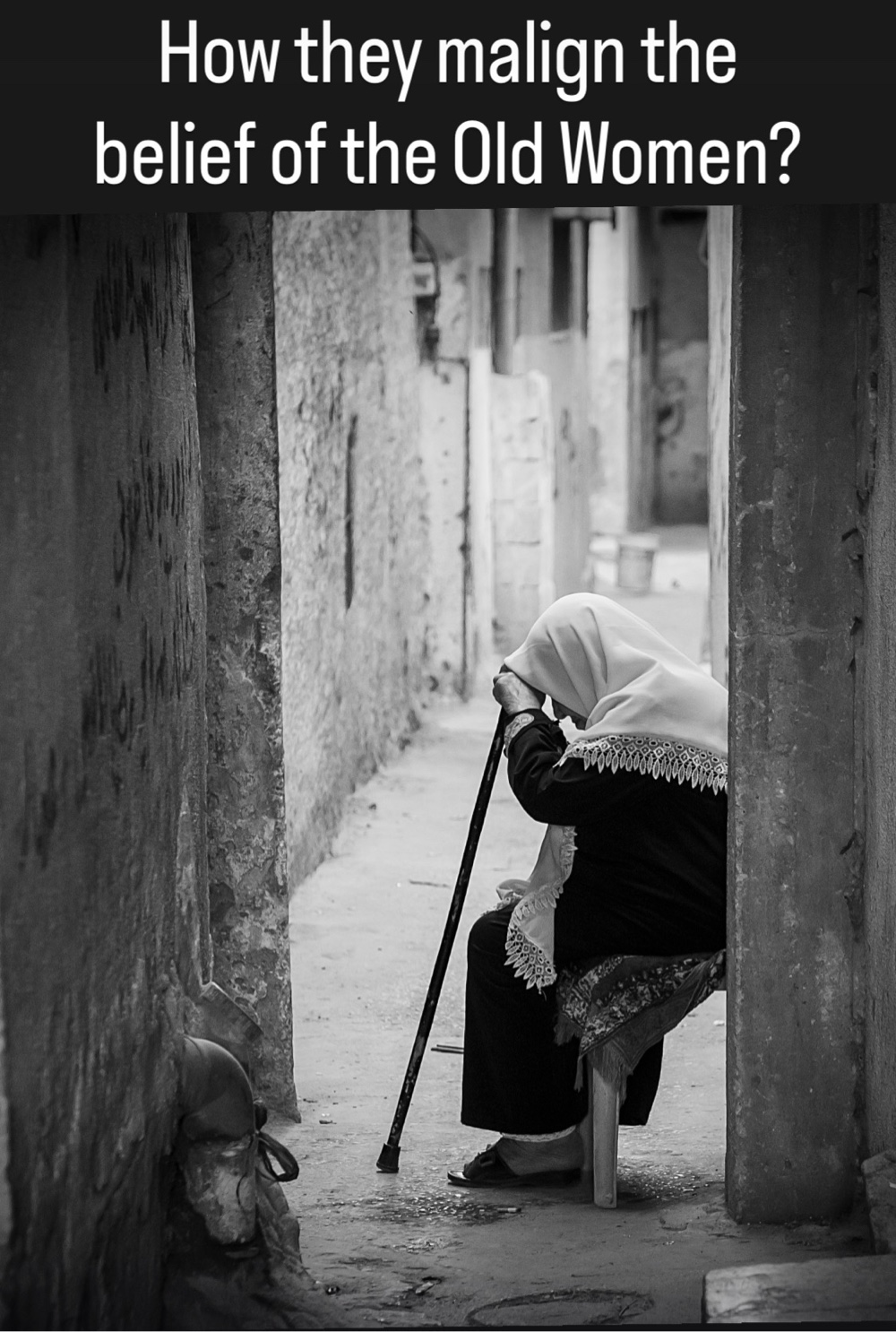
THE BELIEF OF OLD WOMEN
Our Scholars, Imams and Leaders often impress upon us that the best of Iman's is the belief of the Old Women, who say we hear and we obey, and accept things without thinking.
That our youth are awash with asking too many questions, as was the crime of Bani Israel mentioned in Baqara when they were commanded to sacrifice their prize heifer.
That speculative thought is the curse of being brought up within Western Educational norms, and that these should be roundly rejected. And that the Islamic ideal is has a Sufiistic-Tarikah flavour, where the student- teacher relationship is paramount and marked out by respect through not questioning methods, but doing as you are told.
However, when you consider the reality of what our Islam is, then you would come to know that it s both intelligent and relevant.
ABU BAKR, the successor of the Messenger.
When Abu Bakr as-Sadiq (as) said, "if he says it is so, then it be so" [1], our scholar, imams and leaders rightly laud this as the pinnacle of belief, however they often misconstrue it as a blind, unintelligent and unthinking belief- in the manner of the Quranic words "we hear and we obey."
However we know of the remarkable intelligence of Abu Bakr (as) from two undisputed events that happened within the Seerah of our Messenger (saw)-
1- When the Messenger (saw) rose on his pulpit and said "A servant has been given a choice..." wherein the servant referred to was none other than himself, and the choice he had been given to either accept the invitation to return back to his Creator, or to continue until his dominion and Ummah was established.
Abu Bakr (as) was the only one present who realised that the Messenger was talking about himself in third person and was not elaborating a parable, as the other companions thought. He therefore burst out crying.
2- When the Messenger (saw) passed away and the people and companions could not believe it, to the extent that Umar (ra) said that if anyone said that the Messenger was dead, that he would cut of their heads.
Abu Bakr (ra) calmly came to the Messenger and kissed him on the brow, and then went out to Umar, and the companions, and recited the verses that had been revealed after the battle of Uhud that they all well knew- and said that, if anyone worships Muhammad (saw) then know that Muhammad (saw) is dead, and if anyone worships Allah, then know that Allah is the everliving and does not die.
Umar (ra) said that, that day it was as if he heard the recited verses for the first time, although he knew them so well.
So what did Abu Bakr (ra) actually say when told of the great miracle of our Messenger (saw) that only he himself witnessed-
I believe stranger things that that, for I believe that Allah t'ala will raise the dead.
This is an argument given not by one that has not considered, nor thought long and hard but by one who understands.
Indeed when you consider the World and how perfect it is, how it all fits together seemlessly, how there is no wastage and how everything is useful to some extent or for some other agency, then you would say that there is no need for a God. No need for an outside agency, or power, for everything runs so perfectly.
But then when you consider further, and take a step back and your eyesight returns to you confounded by the perfection that is present everywhere, then by rights you should stand in awe of the Originator of the Heavens and the Earth, Who sent Messengers as examples of living life well, with Heaven sent books to wake us to the reality of it all.
This is the argument present within the narrative of the Quran - Look how I have raised the Heavens, do you think that I cannot bring you back to life? Do you think that you are greater than the Heavens that I rasied and maintain?
That our cosmos is strangley perfect, then how perfect the Creator must be?
It is clear that Abu Bakr (as) had deliberated much, and knew that the Messenger (saw) was no liar, nor was he deluded, nor was he as soothsayer for he did not speak in riddles, nor was he a poet because what he said rang too true. He was inspired, and nothing less than a Messenger to the Worlds.
That whatever he (saw) said must be true.
For he withheld naught of what he knew. 2
So why do our Scholars, Imams and Leaders push a view on us which is clearly not true?
For Abu Bakr (as) was the best of us 3, and his belief should be lauded as an example of who we should be.
And it was not a blind belief, but a fully inteligent snd considered one.
ISLAM IS FRAGILE?
Do they really think that our Islam is something fragile, that will so easily crash down when questions are posed?
Our Messenger (saw) said of himself: 4
"My similitude in comparison to the other Prophets is that of a man who has built a house completely and excellently except for a place of one brick. When people enter the house, they admire it's beauty and say: 'But for the place of this brick (how splendid the house will be)!' ".
MashaAllah how intelligent is this man!
He makes the search for the missing brick personal to us by bringing feeling and emotion into the picture.
Compare the version that we have, to let us say, just the first line, which actually carries all of the same information.
If only we had the first line, we would have the same information but it would be a less powerful statement.
It is the secnod line that adds power to the statement.
But what is the Messenger (saw) saying to us here-
Scrutinise Islam, pour over it's every detail, do not be scared.
And if you do so then you will find that it is perfect aǹd without flaw.
Indeed it is the search for the missing brick that drives you, and that the Messenger (saw) placed therein to drive you.
Then what is the flaw that he (saw) alludes to if not the very Hadith that we are contemplating?
However thinking one more level down, the Hadith has served a function and has driven you to thought and scrutiny - so it is not a flaw that can be removed, but it is like a void that needs to be filled, but filled with what if not with understanding.
That you now understand its purpose.
And understanding it's purpose has filled the void that it created. Indeed Islam is so perfect and so complete.
That that is the missing brick that you had found.
So here we see how the Messenger (saw) encourages us to scrutinise, to think and deliberate not just about the Cosmos and our place within it- but about of religion itself.
And see how our scholars, imams and leaders misconstrue our belief.
For our belief is intelligent, encourages scrutiny even of itself. Then what about everything else?
WE HEAR AND WE OBEY
For sure obeidience is due to Allah and His Messnger (saw), that is not in doubt.
However it is a Sunnat Allah that He expounds many times in the narrative of the Quran, that people will differ.
Often He tells us there that it is nothing other than the descent of knowledge itself that caused them to differ. 4
And He tells us in Baqara that of the former Nations that He had allowed the Devil to mix something of lies into their scriptures in order for Him to know the truth of each of them. He therefore alludes to a Sunnat Allah here that is equally relevant to our religion.
But we know because of His promise contained within it that the Quran is itself protected, so given that He informs us of both His will and HIs ways that He wants to find the truth of each of us, and that the Quran is protected - it follows that we need to deliberate well in regards to the second source- the related words of our Messenger (saw).
For He wants to find the truth of esch of us, then will you really defer to authority, when it is your very truth that is in question?
That you will leave your truth or falsity in the hands of another on the basis that they know and you do not?
And isn't this the narrative of the Children of Israel, that they raised their religious classes above God Himself, contained within Baqara?
Are we no better than them, Did not Allah tell of the error of their ways, in order for us to keep away from them?
That we are each morally responsible and that no soul can bear the burden of another.
THE FLUTTERING IN THE HEART
Indeed Our Messenger (saw) advised us not to follow the ruling of anyone if there is a fluttering in your heart.
So if you feel uneasy about what someone says, because they defer to their own authority then do not listen to them. Roundly ignore them, for then you will be following the advice of the Messenger.
So deliberate, ask yourself what is the Messenger (saw) saying to you here?
When will the flutterings of doubt be aniliated?
A man may be wrong, deluded, insincere, and you might not know who he really is.
Authority just does not cut it.
An Imam saying- I'm an Imam so listen to me, hasn't even understood this simple Prophetic Advice.
What the Messenger (saw) should be saying to you here is- follow the advice of the man that gives you reasons, helps you to understand and improves you.
Can you hear his words now?
If he helps you to think and reason it out, if he opens doors for you to help yourself, then follow that man, not the one who speaks Arabic from the pulpit trying to impress, or the one who does not deliberate and think.
At the end of the day, even then people will differ.
And this is a Sunnat Allah, a way of God Himself that we cannot alter.
And those that seek to deny it, by misconstruing "We hear and we obey", they are those who just don't understand.
That people will differ in their opinions and we must choose wisely, and those that seek to deny that differing by unwisely demanding conformity against a SunnatAllah that He puts there to find each our triths, these just do not understand.
SPECULATION IS WESTERN IN ORIGIN
Submission and Belief are two completely separate things, having two different natures.
For whilst Islam is perfect and complete, it is a house with a purpose- to protect us and keep us safe.
And here, when we have determined a truth- it is for us to hear and obey. That the command lies with God and His Messenger (saw).
But Iman is an inward journey of discovery and the guidebook on your journey is nothing less than the Quran. Indeed the Quran never does it address the Muslim, never does it says "O you Muslims", but always "O those amongst you who believe", and rebukes the Bedouin with the words "Do you say you are believers, first say I have submitted myself in Islam".
And when you examine the Quran, it is replete with simmiltudes, parables, concepts and ideas that need internalising- and that process is speculative. How can it be other than that. "Why do you not think?" Is a common refrain within the Quranic narrative.
Once again we find the rebuke in Baqara said in relation to the Children of Israel, and actually aimed at us
Why did they not think?
The idea that our former great prior generations were not speculators is just not true.
If we reverse 500 plus years, Europeans lived and died within their same parishes, the son took the job of the father and no one questioned anything past the borders of their shires. Whilst Muslims distilled alcohol, created whole industries of Pharmaceuticals, innovated in musical instruments, made robots, looked into the cosmos, created great works of literature.
And you think that Muslims then weren't speculators?
Indeed the very narrative of the Quran encourages us to be so.
So many times Allah t'ala talks about Taw'il, explanation or reason:
That is the best explanation.
Those who are best are the ones with the best explanation.
But it does not at times clarify what it exactly means, because the speech wants for you to find the best explantion for yourself.
And how can you do so without considering differing explanations, without speculating?
Indeed one explanation is that Allah t'ala is commending to you the exploration of consequence, that the best explanation is provided not by the measurement of absolute quantites or attributes like truth and falsehood, but by you deliberating what each of differing explanations means in terms of conseqence.
And that is tantamount to the creation of a speculative mnid.
For that deliberation is not an exact science and is speculative in nature because it examines future or eventual consequence.
Speculation was our game and our forte.
But now that torch passed to the Western world, and you would fain take it back, saying that it is a tainted green apple- when it was always ours?
NOTES
[1] on being told of Israa,
2- Surah Kowirat.
3- Narrated by Jabir bin Abdullah (ra)
4- for example Aal-e-Imraan v19, then try snd understand the instruction contained in v18 for mankind.

