Friday, 23 July 2021

The Pillars of Freedom and the everyday fight against the Status Quo

*We are each very much determined by the choices that we make, even past the daily choice to believe and submit*


A man may know everything that there is to know about the religion, but if God does not bless him with belief then it will not profit him. This because he does not choose belief, and so God does not confer on him the honour of it. 


Indeed even those choices that determine who we are, do not stop once we choose belief over disbelief. 


Look for example at Az-Zumar v18, and then read how several of our English translators have chosen to relay its message. 


And then look at the bare bones of the Arabic and see if you can yourself decipher it:


Those that listen to the speech (in reference to the Quran being God’s words and speech) so following the best (of or within) it. They are the ones guided by God, they are the doors (to understanding). 


The connective here “so” indicates that listening infers following or obeying. 


But the question that is posed by this verse is what does the “best” refer to. 

Surely we believe that the whole of the Quran is the best of speeches, and that therefore we follow all of it. 


In Yusuf Ali’s version we find that he interprets it as meaning. That it refers here to the meaning contained within God’s speech. And not the part of God’s speech which is best. 


Interestingly here we can see how the verse once again refers to itself. 


That we have a choice as to how we interpret it, since there is a best meaning, better meanings and therefore not so good meanings. 


That those are guided who interpret it as referring to the meaning contained within the speech of God. 


But what is most incredible here is that God is informing us that we must deliberate and think and choose the meaning which means the best. 


And how do we know what the best is. 

Well that is exactly your choice of what you feel is best. 


That it is our choice of what is best that will determine who we are. 


And then it is those who teach you how to deliberate and think about these things, God calls them “the doors”, “the conduits” to better meanings. In similar reference to how the Messenger (saw) said of Ali (ra) on returning from the farewell pilgrimage;


“I am the city of knowledge and Ali is it’s door (gate)”. 


There are many choices that we must consider and make when we consider the religion:


1- Was Muhammed (saw) sent to make things clear? And what does this mean?


2- Did Muhammed (saw) withhold ought of what he (saw) knew of the hidden world? Or did he (saw) relate to us all of what he knew? And what does this mean for us?


AND...


3- Is the religion by construction naturally against the status quo, against the accumulation of power or even those who claim “the best meaning” of it?


Our scholars knew well the influence of power, and avoided it like the plague. 

Lest they became a vessel for oppression and wrong, as opposed to understanding and freedom. 


Lest they could be accused of towing the line of power, or of being accused of being sell-outs. 


And that even where they stood to gain nothing of monetary value, for they knew well that nothing is free and every favour has a cost. 


In our times being politically correct and forgetting our great heritage, and the basis of our civilisation that brought the World out from the Dark Ages. 


Such are the worries that governed them, such are the worries that should be ours. 


For was not Musa (as) sent against the oppressive ruler Firawn, and Isa (as) against the Pharisee, Scribes and Priests of the Children of Israel, and Muhammed (saw) against the mercantile and wealthy custodians of the Holy Kaba. 


And are we not warned in our book against being like those that took their priests as gods other than God?


At the height of our civilisation the Qadis (judges) were fully independent from power and the executive. And each gave their opinion according to their understanding of the Quran and Sunnah and the people were free to take one and leave another. 


There was no compulsion upon the people except what their own conscience dictated. And the executive were free to make laws for the benefit of all, and were advised by the Most Gracious to first consult the Qadis. (S An-Nissa). 


Ours was a society full of freedoms and full of innovation (in worldly matters). 


Consider that at the time of the Messenger (saw), that the hypocrites were not stopped from building their own Mosque. They did not have to apply to gain a permit from any central authority. 


And that it was only when it was clear that that Mosque was a den of intrigue that the Messenger (saw) was commanded to move against it, and destroy it. 

Recall that the perpetrators remained free even after that, and were not brought to account. 


That they were allowed to build it in the first place is instructive to what our society is supposed to look like. 


The people should be free. 

And the religion is necessarily grassroots, open to all, to both seek to understand the better meanings, and to bring them to fruition. 


Just as is our society. 

Necessarily grass-roots, where the people are free to organise, and remain under the radar of man-made institutions. 


Whereas our institutions are God-sent, as ideas that we are each free to build to fruition. 


Recall  that the Messenger (saw) informed us that the sanctity of one Muslim life is more sacred than the bricks and mortar that constitute the Kaba. And that when we stand before God we are commanded to face the Qibla. 


Our institutions are our ideas and ideals that stem from the best of meanings contained within that which was sent down : the Quran and the Sunnah of Muhammed (saw). 


Knowledge is sought through study and contemplation. Not lectures, nor talks, nor this above. 


Wednesday, 14 July 2021

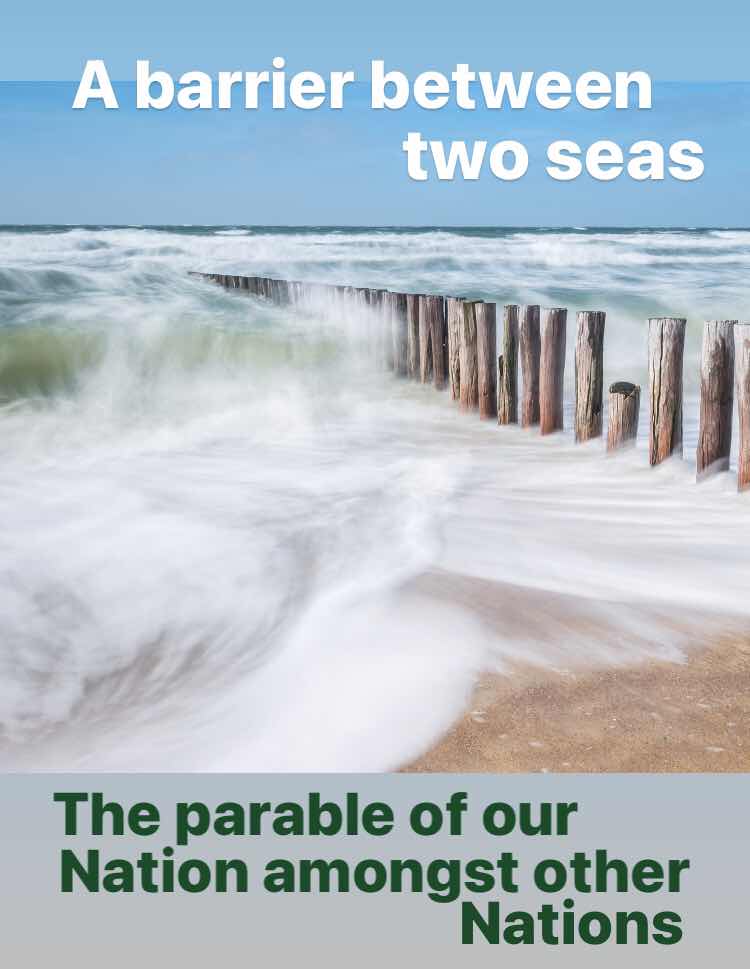
The Necessity of Our Distinct Nationhood

“And it is He Who has let free the two seas, one palatable and sweet, and the other salty and bitter, and He has set a barrier and a complete partition between them.” S Furqan


These are the days of Hajj when we recall and remember the first Muslim family, their trials and tribulations and how they met those with honour, patience and faith. 


Very much of what we have today emanates from that first family. 

For whatever Ibrahim (as), Abraham the intimate friend of God, supplicated and asked for, God granted (except for one).*1


From the supplication for each of his sons and their progeny:

1-Isaac (as) from whom came Yakub (as) and then the Children of Israel and a plethora of Prophets, that we homage to and correctly claim as our own. 

2-and his first born son, off the handmaiden Bibi Hagar (ra), Ismail (as) and Ibrahim’s supplication to bless his and their place of dwelling- Mecca. 


To his supplication to bless the Umiyoon (the unlettered dessert Arabs) with a messenger from amongst themselves, that laid the foundation for the coming of Muhammed (saw). A verbal message from God to the whole of the World through an unlettered Messenger. which has been kept alive 1400 years on the tongues of the Believers. 


One of his greatest other supplications was to make him not a trial for the people, and then for him also to have honourable mention on the tongues of truth. 


It is interesting then to note that the Quran is a Message from God to all of the Nations and all of the People, whilst at the same time being the foundation of our society and our faith. *2


And that in answer to that supplication of Ibrahim (as) to not be a trial for the people, that God made him a Messenger without a Nation. For a saying of Muhammed (saw) has it that Ibrahim will be raised as his own Nation. 


Then wonder at how much God honoured him. For the greatest of our worship is the Hajj, and the akham of Hajj (it’s rules and regulations) are the pinnacle of our Shariah (Law). 


So that whilst Ibrahim (as) had no Nation. God made him the father of the Nation of Muhammed (saw)- here read the last verse of Surah Hajj. And the rules that define that distinctly Muslim Nation find greatest expression in the rules of Hajj, and were the last to be made clear (during the farewell pilgrimage). 


And then in that same last verse of Surah Hajj, God talks about the characteristics of our distinctly Muslim Nation. 

So that we as a Nation are a trial to other Nations, holding them to account and exemplifying that which is better for them.  


That whilst Ibrahim (as) asked not to be a trial for the people, we who are his Nation were intended by God to be that trial for all of the Nations of this World. 


That there is something necessary in God separating us from them, even whilst we affirm the essential unity of Man. 


Then ponder at the verse in S Furqan given at the start. Look at the verse that precedes it. 


“So obey not the disbelievers but strive against them with it. (That is) a great striving.” (V52)


In former writings I have said that the Quran is replete with self reference, and that the pronoun it here is usually interpreted as the Quran. 


Suppose here that the pronoun “it” here refers to the striving itself:


“So obey not the disbelievers but strive against them with striving. A great striving.”


Directly following on from that we have the palatable sea and the unpalatable sea and the barrier that none can cross except by God’s leave. 


This sign of God in such a place means that we should seek to interpret it allegorically. Since we recall from Baqara that God disdains not to take the similitude of the gnat, it is clear that when God makes a similitude He uses things which are real and actual. 


Then the similitude of the two seas are belief and disbelief and the barrier is the Shahadah - the testimony of faith. 


We, as a Nation, recognise the ultimate unity of Man, and hold out for all Nations and all Men that goodness exists within them and only needs our help to find that expression. 


And our help is given best when we whilst recognising that all men are equal, erect a barrier between us and them. That they know that we are different, that we treat all equally and with justice and that to come within our brotherhood / sisterhood is solely one sentence that they need to declare: that there is no god except Allah, and that Muhammed (saw) is His Messenger. 


It is our society that perfectly exemplified that barrier, where we are duty bound to protect the non-believers and where the sacrifice is asked of us and not of them. That we are the ones that are expected to give to the utmost hilt, whilst they are the ones who are protected by virtue of the Jizya. A more perfect barrier there never was. 


Looking at the same sign from God is Surah Rahman, we find a different allegory waiting for us to contemplate. 


That the pearls amongst mankind can be found throughout all Nations. 


Then it is our requirement to erect that barrier, and make it both strong and yet porous. That the people might feel inclined to cross it and enter into the sweetness of true faith. 


Knowledge is sought through study and contemplation. Not talks, nor lectures, nor this above. 


Thursday, 1 July 2021

Hell, an evil destination for those without regret

“Where were you before you were born?”


Of all of the systems of knowledge that offer a solution to that question all of their answers are arbitrary, most revelling in their arbitrariness, and none come close to the depth and certainty of the answer offered by Islam. 


Within our corpus of knowledge even our unique prayer with it’s circuits (rakahs), takbeers and tasleems (salaams), are God sent. Having been revealed through Gibreel (as)  (the angel Gabriel), coming in the form of a man and teaching the prayer to our Messenger (saw). So much so that the many wisdoms of our prayer are readily there to be deliberated upon. 

(Since our prayer was not constructed, but instead sent down from above). 


Another question that proves to be a dilemma to other systems of knowledge is the question and problem of evil. 


And it is for this reason that Atheists love to debate believers is in regards to it: 

that how can a good God allow for us to suffer evil. 


And the solution they, when pressed, offer once again resorts to revelling in the arbitrariness of relativistic morality. 

That there are no absolutes. 

That morality is not a given, but is a human construct, that we can therefore choose to change. 


That taking a life within civic society is a crime, whilst taking it on the field of battle is both a duty and an honour. 

But here they fall into the trap of proving their lack of subtlety, that they want not to see the difference between the two circumstances. 


However, the question of evil is tied up with the question of Hell, another lance in the hands of many atheists. For how can a good God allow for an eternal punishment in Hell. 


For indeed without doubt God is the source of all goodness, due all praise. 


And Hell is without doubt real, and we ask God to save us from it. 


And Heaven is without doubt real, and we ask God to enter us into it. 


And furthermore there is no contradiction between all these three statements as fact. And this can be seen when we fully immerse ourselves within the Quranic narrative. 


That the very creation of the Heavens and the Earth, with it’s balance and perfection, is due to the fact that the very fabric of the whole of the cosmos is underpinned with a belief in God. 


That God determined to set up on the Earth one who had free will. 


And then empowered that one with the power of names so that he and his children (Adam (as) and all of mankind) had both the capacity (authority) and instrument (names of things and therefore the language) to enact their free choice. 


That whilst we have free will, none can act to fulfil his free will except by God’s leave. 


That when man utters blasphemies, and commits crime, the very fabric of existence revolts against him. 


But it is God’s rahma (mercy) that compasses even the criminals amongst us. That they are given respite so that they might regret and make amends. 


That God has given us all a conscience that calls us to good, to regret the crimes that we commit, to make amends and ask for God’s pardon and forgiveness. 


Imagine after all of those chances that God gives for you to make amends, that those who commit crimes against very existence itself (blasphemy against the one True God), or against fellow man, they have brought God’s ultimate goodness into disrepute. 


They have made God an accomplice to their crimes, for they could not do save except by His leave. Then God’s wrath against them will not be diminished. 


And their destination is Hell. 

An evil place because they did not regret. 


And yet for the Believers even Hell is a blessing, for fear of it prevents us from wrong. And that is by far a great blessing. 


And it is for this reason that it is mentioned in Ar-Rahman. 


Knowledge is sought through study and contemplation, not through lectures, nor talks, nor this above. 


Tuesday, 15 June 2021

Our Most Civic Duty

“Obey those placed in authority above you” (*1)


As a people we tend to hold authority in respect, so much so that we all to often fail to hold it to account. 


That we are required to do so can be seen in the first address of Abu Bakr (as), where he emphasised that most civic duty. 


For excesses of authority lend to tyranny. (*2)


And in the Quranic narrative these are the Taghut that will inevitably be destined for the lowest reaches of hell. (Read on from the greatest verse in the Quran; Ayatul Kursi, and contemplate the real example of Nebuchanezzar given there).  (*3)


This therefore is not a theoretical concept for a lazy day of contemplation, but it should be a very real worry at every corner of our civic lives.


For also within the Quranic narrative oppression is twinned with disbelief and freedom with true belief. (*4)


When we read the Seerah with contemplation we see how the Messenger (saw) was keen not to overstep his remit. 


How he consulted before the battle of Uhud on the appropriate course of action. 


How he was fully aware that the treaty of Aqaba held that the Medinese were bound to defend him against his enemies, but that an offence; even when that offence was for the defence of their own land and in their own interest; had no remit within that treaty. 


And this even with regard to his undisputed religious authority. Then what of others’ authority which rests solely on “the one who best serves the interests of the people”. (*5). 


Here is the high bar of checks and balances that permeated all of true Muslim society. 


That Abu Bakr (ra) worried about his stipend. 

That Umar (ra) eagerly asked Uwais ul Qarni (ra) to make supplication to God for his forgiveness. 

That Uthman (ra) did not retaliate against those that raised insurrection amongst us. 


That all authority needs to be held in check. 


That privacy within our society is of paramount importance, made clear by a saying of the Messenger (saw) carrying the weight of the whole of the religion. 


That we believe in the innate goodness of all people, even when they do not profess the Shahadah, and are not overtly Muslim. 


That those that police us do not hold unchecked power to snoop and make their case. That therefore policing is or should be confined to the public realm, unless what you do in private impinges on the rights of another, and sure evidence or multiple independent testimony can be brought to bear. 


How perfect our society where a single accusation carries no weight. 

And freedom is not a token of speech. 


How backwards this society where the wheels of justice grind slowly, and even slower for those wrongly accused, who then might often succumb to doubt. 

And where you are free to wrong, be watched every step of the way and not prevented, but instead facilitated. (*6)


In the name of doing the right thing, upholding justice and championing the victims, they would steal the rights from the majority and put us all within a country wide prison of state surveillance. 


It is fear that dominates their every thought. It is fear that blinds them to the (societal) harm that they cause. 

It is fear that cements their racism and bigotry.  


But for the Muslim, there is ever hope. And hope ever trumps fear, just as belief ever trumps faithlessness and disunity. 


Our society needs to be free from racial bias, and the only society that has proven true to that standard is Muslim society which is grounded both in the Unity of God, and the commensurate unity of Man. 


A true system of justice needs to be fair, open to all, un-encumbered by convention, grounded in a set of independent checks and balances, and policed by a force that is above reproach and answerable to the courts and not the executive (government). (*7)


A force that is not free, nor left unchecked. 

Working for a people that were born to be free to believe, free from tyranny. 


Knowledge is sought through study and contemplation. Not through lectures, nor talks, nor this above. 

NOTES TO FOLLOW IN COMMENTS


Wednesday, 9 June 2021

The Personal Love of God

“If music be the food of love, play on, play on”


The motivating factors that move us and cause us to act in an active fashion as opposed to a passive one are few:


Jealousy 

Spite

Greed

Anger 

Shame 

Revenge 


The need for recognition 

and not least Love. 


In referencing the motivating factors that move us towards negative and destructive ends, God in the Quran reminds us that He is the Lord, Master and Answerer of Supplications of ALL MEN. (S An-Nas). 

And that therefore we are not special, even though we might think that we are. 


The need for truth, justice and fairness is a principle that we must strive towards, but the thing that motivates us towards that noble goal is essentially love. That we love to be good, selfless, true and fair. 

There is something beautiful about these principles, that we admire. 


Love is the only real positive motivating factor. It is desirable, positive and giving. 

But it is not in itself selfless.


Those of us that live our lives according to principles, love to be selfless. But love itself is not selfless, but neither is it selfish. 

It is something that God blesses us with, and puts between us, for He is the source of all goodness. 


It is constructive to compare the Muslim idea of this with our religious forbears and cousins. 


The God of the Old Testament is a jealous God. And it is this trait that defines the Judaic Nation throughout history. 


In a Hadith Qudsi we have that God says I am as my slave believes me to be. 


For the Christian Nation God’s love is selfless and unconditional. God loves all. 


And it is these ideas that we need to constructively consider when we contemplate our religion and our texts. 


For our understanding is much more nuanced and much more intelligent. 

God’s mercy compasses all, for He is Ar -Rahman, and His mercy compasses even those that deny Him and are rebellious. 


But His love He reserves for those who do good, as is referenced so many times in the Quran. Here His love is conditional. 


For the Judaic Nation if God loves then He makes easy and supports you in stealing others rights, and oppressing them. For He loves them here in a jealous manner, reserving things for them whilst denying it to others. 


But for the Muslims this is a clear sign of God’s anger with you, that He loosens the rope that you may hang yourself by your evil deeds. (Vis a vis the story of the creation of Adam (as)). 


When we look at the early life of the Messenger (saw) then we can see how God’s love really becomes evident. 


When God loves you He protects you from harming another, guides you to a better way, and helps you towards Him through at times what look like hardships to others (even if those others cannot see the effects). 


These are personal miracles that God sends your way. That only those who believe can feel. 


And then God’s generosity knows no bounds. For He opens hearts for you, and removes from you those who are your enemies. 


And then even whilst God is arRahman and His mercy compasses all, He reserves His anger for the wrongdoers who oppose those on the truth. 


Allah t’ala says Lana’t’Allah- that God has cursed them. Why does He say that He has cursed them, even whilst they have cursed themselves by their injustice and their championing of wrong?


This is a difficult question to answer. 

But what is clear here is that this is something very personal to God, himself. 

For remember He says here- I have cursed them. 


And then it is clear that God’s love of you is conditional upon you doing good, but once you attain that station then His love of you becomes something personal to Him. Just as in a like manner if you oppress, and persist in oppression, then God’s hatred of you becomes a thing personal to Him. 


Interestingly here God is the God of all,  vis a vis the Christian idea of selfless love, whilst at the same time being similar to the Jewish idea where God’s love or hatred is something personal to Him. 


We are lucky as a Nation because we know how to attain to God’s love. 

And that is through upholding justice, being true, selfless giving, returning trusts and exhausting ourselves at the times when we are asked to exhaust ourselves (Ramadan and Hajj). 


The way towards knowledge is through study and contemplation. Not through lectures, nor talks, nor this above. 

Thursday, 27 May 2021

The Limits of the Hadith Sciences and the Heart of the Quran

“Every field of knowledge has its limitations, just as the Messenger (saw) was eager to ensure that we knew that even the religion has its limits”. 


The remit of a Scholar of Hadith is that they know the isnad, the chain of transmission from one generation to the next, and can critically appraise it. 


Often since their remit is not to examine the internal consistency of Hadith, nor it’s external consistency, nor look past its isnad, they do not do so. 

And in not doing so they miss much. 


It would be beneficial to look at a specific example to bring this point home to you. 


For some of them say that the Hadith, in which the Messenger (saw) calls Surah Ya Sin the heart of the Quran, is weak. And yet it is culturally significant in that many of us have taken that Hadith to heart. 


Some even go so far as to say it is fabricated. 


But they do so by only examining it’s isnad. 


The chain of narration could have be broken with a missing link, or even one such individual that they considered untrustworthy, could have this one time narrated it correctly, and it could be a true saying of the Messenger (saw). 


Except one that is not verifiably true by the exacting standards of the Hadith Sciences. *3


Furthermore it’s not like the narration is critical to our understanding of the religion.  


And so let’s look at this particular Hadith a little more carefully, and a little more in depth. 


Either the Messenger (saw) was referring to the position of YaSin within the Quran or he was referring to its standing within the Quran.  


Yasin does not sit half way in our Qurans. 

And so it must refer to its standing with respect to the Quran, and the effect it has on it’s people.


Figuratively the heart moves us to action and enervates us. When we say something is the heart, we emphasise it’s desirability. 


Now read Yasin keeping that meaning in mind, and see if you can decipher the class of people it is meant to move to action. 


Here you will need a rudimentary understanding of the Seerah, of the classes people to whom the Messenger (saw) was sent. (*1)


Now imagine that you are one of those class of people, and read it as if it were talking directly to you. Does it not move you?


And would it not move you to incredible feats of endurance and sacrifice?


Not because the argument appeals to your intellect. But because it appeals fully to your heart. *2


And that it did indeed move that class of people to an incredible and unprecedented action, that forever changed the course of the World’s collective history, cannot be doubted. 


So that when we look at it now we do not need to know that it’s isnad is not intact. 

It’s truth is self evident. 


It’s interesting to note that many scholars of hadeeth narration, notable amongst them an-Nawawi, collected forty hadeeth. 


They did this in accordance with another saying of the Messenger (saw) in which he said that one who transmits forty Hadith from him would attain the class of one who understands the religion. 


Now take your time to contemplate that. 

There are two beautiful gems that can be gleaned from that saying. 


First we know that Allah t’ala is One and loves the odd (another well known Hadith). And that very often in our corpus of knowledge seven, seventy and seven hundred are numbers that are equated with the symbolism of a great many or a great quantity. 


But here in this one transmission that lauds transmission itself, the Messenger (saw) stops short of seventy. 


It is as if he is telling us that it’s not the quantity of Hadith that you learn and then transmit, but it is the quality of understanding, that really matters. 


And then this truth is brought home by the next line. That one who does so attains the  level of one who understands the religion. 


And that therefore the one that understands the religion is at a higher level than the one that transmits.  


A truth that the Messenger (saw) hinted at the farewell pilgrimage in front of many thousands - those that are here tell those that absent, perchance they may be the ones that better understand. 


The mother of Islamic Sciences is Tafsir ul Quran, and deliberating on that alongside the Seerah of the Messenger (saw) - per chance Allah t’ala might bless you, and us all, with understanding. 


Knowledge is sought through study and contemplation. Not through lectures nor talks, nor this above.