Thursday, 20 June 2019

The foundations of Muslim society

Is it not remarkable that within the first ten verses of the S Baqara, at the start of the Quran, that Allah talks about the hypocrites?


It is not remarkable when you consider that He chooses to preface the Quran, and everything in it*, with His name and attribute- ArRahman- the Most Merciful. 

For we, the Children of Adam, are a social and cogent creation, that live our lives within social hierarchies and groups that determine everything about us- from what we aspire to, to what we achieve, or do not achieve, to the method of our living and eventual dying. 

That He would then want to bless us with the best and most just society, and so He starts the Quran with Baqara which is the foundation of our society. And then starts Baqara with warning us about those nefarious elements that will seek, at every turn, to undermine our society. 

Indeed of the five pillars that make the house of Islam, only the first two were revealed and made obligatory in the first thirteen years of the Prophet’s (saw) mission that was marked by Meccan persecution. 
And the prayer that we perform was then both a consolation, a means of attaining closeness, and a source of contentment and happiness in those trying times. 

Whilst we find the command to establish Salat (Prayer), that is most often heavily tied with paying the Zakah - poor due- in the Quran, were clearly revealed after the establishment of the Muslim polity. Just as were the fast of Ramadan, and the culmination of Ibrahim’s (as) religion with the purification of the Hajj. 

It is these five that determine how our society should be, and look. 

The happiness that springs from Salaat, where gratitude to the Creator preempts a gratitude to all. 
And where we are all brothers, as equal teeth on a comb- no matter our wealth or our heritage or our colour- we stand side by side. 

The need, by a rule and institution, to care for the less well off- not because of a guilty feeling, nor because of a demeaning charity- but because of a God Given right. 
(Zakat). 

And then the feelings of empathy- when you feel as they feel- and you know the hunger that they taste and the thirst that drives them to despair- that is our fast of Ramadan that enables us to give with compassion and with heart.

Imagine Allah’s grace, that He chooses for you a religion that makes us as a body - one. 
Without social division, without classes and hierarchies of wealth, without superiority or inferiority due to race or colour or heritage. 

For did not our Messenger (saw) say in his farewell sermon in front of thousands of Arabs-

“No Arab is superior to a non-Arab”. 

On the Day of Arafat, 
On the Day when that favour was fulfilled and Islam was perfected. 
On the Day that Omar (ra) wept. 

O Allah send our salutations upon the Messenger, Muhammed (saw), for he did eminently discharge his duty and we have believed in You and call him true. 

Who taught us that Islam is more than a religion, in the strict sense of the word, that seeks to build a just and true society where happiness prevails and freedom flourishes, and the believers are as one brotherhood. 

Ameen. 
*excepting Tauba. 

What I have said here is my opinion. If it is wrong then that wrong belongs to me. 
Knowledge is sought through study and contemplation, not via lectures, nor speeches, nor this above. 

(Note: it will be an exercise of excellence on your part to find and read the verses in S Baqara that commend and command each of the five pillars of the house of Islam.)

IMAGE:
No copyright infringement intended. 

Plainly the analogy of the religion being a house is intended to show that it is both constructed and solid/ real. And the 5 pillars are there to hold the roof over our heads and protect us all. 

We each harbour multiple Personalities.

Following on from the session we had about multiple personalities, it’s interesting that whilst we found it difficult to agree on certain definitions (identity, personality) some things did transpire. 

So I think that we agreed that in our youth the experience was that yes we have multiple identities and were not simply wearing different hats. 
The difference between the two is that “hat” here denotes a role that you play- and is characterised by volition, that you choose to put on that hat- whereas a change in identity happens unconsciously. 

I would say that early in life we are socialised into recognising authority, and adjusting our behaviour to fit. 

In youth when we are amongst our peers, the bounds of what was acceptable behaviour in the past are stretched, so that then we experience a dichotomy. And we become adept at knowing what is acceptable and unacceptable depending on circumstance, so much so that our character seamlessly changes when we transition circumstance between home, school and the mutual company of our peers. 

Here what appears is the start of multiple personalities or identities. 

And then as we age, we gain authority and once again the boundaries of acceptable and unacceptable behaviour change, and if we are not careful then we become adept at using our authority to the extent that we may even become sociopaths. 

This fear of authority never really leaves us, but it does get sudstituted by those we deem our betters. 

It is interesting here to quote Shakespeare, (foremost) “to thine own self be true”. 

I think that we all agreed that this sentiment is something to be tried for. 

It is interesting that Shakespeare got one of his characters to advice his audience, and us here, not to play a part- not to adjust your behaviour to satisfy your audience- but to be true to your own self first. A single identity that is true to yourself. 

And my question here is that it appears to me that in order to be true to oneself requires the acceptance of a greater authority that does not change with time, that is the Everliving, the Most Gracious?

Monday, 15 April 2019

Say Not That

Say Not That

Say not that they died 
Where a stood 
When they stood against oppression 
And wrong 

Say not that the battle is over
When it is not yet won 
And ere the sun rises 
Another day is begun. 

Say not that force of arms 
Are the only wars worth fighting 
For to hold the peace 
Is as of a thousand of all things 

Say not that walls protect you 
Whilst you cower behind them 
And the Capitalists monetise your fear 
Forgetting they once cared 

Say not that Democracy is dead 
When the party’s wants trump the peoples’ need
And you have yet the wind in your veins 
And the blood in your sails 

Say not that it can’t be done 
For all things start as possibilities 
And it takes a drop to cause a torrent 
And a river gushing forth. 

(C) Shafeesthoughts 14 April 2019
Flying home from Tunis. 

Friday, 29 March 2019

Entitled

Assalaamu Aleikum 
Jumaa Mubarak 

What primarily distinguishes the Sunni from the Shia is our marked lack of regard for personality. 

They can literally be rendered as “way / method” and the latter as “party”. 
The first being a reference to the way or method of the Messenger sent from God (saw), and the second referencing the people that supported Ali (ra). 

Of course the exception that we both agree upon is the Messenger of God (saw) whose life is both an open book, and a miracle in every respect just waiting to be read and contemplated upon. 

And then we do both hold people in regard, except the Sunni is not surprised by imperfection and error in another and compensates for it, and forgives because of it. And is thankful for the aid that one can provide to another. 

Whereas those other ways have a similarity to personality cults, which admit no error and gloss infallibility over people who simply have either charisma, or a birth right, or both. 

Indeed our very testimony of faith- there is no god but Allah, the true name of the Most High- admits that there is no power or authority except His, and those that He endorses. 

Therefore we are unique amongst the Abrahamic faiths in that we have no priesthood, no one that can claim an exclusive access to the Most Gracious. 
That Allah is ever near, to each and every one of us, ready to answer our call when we ask. And if we wrong, then forgiveness is but a sincere ask away. 

Then is it not sad, when we adopt and encourage a preponderance to titles. 
The natural culmination of which is the plethora of our celebrity Sheikhs. 

Indeed an Imam is not a title, but is a position. 

When a man steps forward he assumes the responsibilities incumbent on him in performing that role. 

Likewise “those that know” are not entitled in the Qur’an- they are simply those that have ability and are to use that ability towards the betterment of others. 

Their role is to provide answers and help people to appreciate and adopt those answers. 

For there are no Sheikhs in the Qur’an, but there are “people who know” whose duty it is to make their knowledge both relevant, accessible and understandable. 
And then also help those more able on the paths towards knowledge. 

The fixation with personality, and the adoption of various titles of no consequence is not the Sunni way, and is not part of the Sunnah. 

Knowledge is sought through nothing except study and contemplation, and we should all be on that path. 

There is nothing in a title, but everything in the act of helping others. 

When the Messenger (saw) was asked by a stranger to the Polity of Medina, “Who is your leader?” He responded without pause, “The one who best helps the people”. 

A lesson that was learned well by our next two heroes, who were most vested with continuing the Message of Islam, for they hated to adopt a title and then later settled on “Khalifah t’ RasulAllah”. 

So much so that the second of the two had as his “Khalifah t’ Khalifah t’ RasulAllah”. 

Both literally 
“The successor of the Messenger”

And secondly 
“The successor of the successor of the Messenger”. 

They both of them disdained from the now loved “amir ul mumineen”- leader of the believers which was only adopted as a title after the titling that they had started became cumbersome. 

For Uthman (ra) did also originally adopt the triple successor of the successor of the successor of the Messenger (saw). 
Until it’s cumbersomeness became all to apparent. 

Islam is an open book. 
And the Most Gracious is ever near. 
And the best that you can ask is for His guidance. 

If He were to guide you then none could lead you astray. 

But if He were to leave you to stray then none- not the most educated, nor the most celebrated, nor the most titled- could guide you and keep you safe. 
And thankfulness belongs to all, from the least to the most.  

Imagine brothers, if this message had been taught from the pulpits as it should be, then we would not have those gullible enough to believe that a man claiming to be a caliph - by the very fact of his claim- was so. 

What I have said here is my opinion. If it is wrong then that wrong belongs to me. 
Knowledge is sought through study and contemplation, not via lectures, nor speeches, nor this. 

Monday, 18 March 2019

the Denial of Disbelief is not Faith


The denial of disbelief is not faith. 

For the Messenger (saw) told us that faith and belief has 70 branches, the least of which is removing harm from the paths that people walk. 

Whilst it’s true that the soil of your heart needs first to be cultivated by the removal of false gods, from vanity to envy, it is not this alone that can cause the tree of belief to take root in you. 

Imagine that least of a believing man that removes harm from the paths- 

Contemplate him. 
Who is he?

He is a man, or woman, 
who is considerate
not of those that they can see
-but of those that they see even when they are not there
-those that might just be harmed, 
not by them nor their actions,
but by things that just happen to be. 

They are aware of what harm might happen through their inaction, through their inattentiveness, and through the dullness of their heart’s eye. 

Measure yourself against such a person. 

To be considerate and to care for the “maybe” people, even when it is just a “supposed eventuality”, that is the least of faith. 

How can we cultivate that full consideration, of invisible future outcomes, without first 
the kind word, 
the warm smile, 
the consideration of how those feel that we meet, and live amongst, on a daily basis. 

Uwais al- Qarni (as) was not blessed other than because his obligation prevented him from meeting the hero of all of us. 

Fulfil your obligations to Allah, and then to those that your are obliged towards. 
Give thanks to God, and those that helped and aided you. 

A saying of his and our hero, our Messenger, has it that a half of the Qur’an is the Chapter of Convulsions (Zilzalahah). The Hadith might be classified as weak in chain of narration, but it’s content is sound. 

Every man shall see the profit of his hands.  
And the good that you send forth might dissipate as atoms that you can’t see in this life, but no less effect do they have on those other lives that you touch. 
And in what comes next all of those atoms weight of good will be yours to see and take comfort in. 

Good enables and sustains good. 

That is why faith is a tree, 
Because it is living, 
breathing and growing. 

And it starts with being considerate, 
And kind to others. 

What I have said here is my opinion. If it is wrong then that wrong belongs to me. 
Knowledge is sought through study and contemplation, not via lectures, nor speeches, nor this. 

Thank you, to each and everyone of you, who make our lives, together, so special
 🙏🙏🙏

Friday, 1 March 2019

Not a fifth column

Orientalist focus has shifted. 

They still seek to undermine the historical basis of our culture, casting false doubts over mutawatta... that which has come down to us from various independent sources. 


Indeed it is opportune that attention to detail in historical analysis originated within our own body of knowledge, well before anyone else. 

In this age they enlist our own academia, even the likes of Al-Azhar, against ourselves, when they support doctorates that declare that when we live in Ireland, per se, we are living the closest to an idealised Islamic lifestyle. 

It is no laughing matter when they grade each country, or society, according to an Islamic Index that shows that Muslim countries are the bottom of that pile. 

It is no laughing matter when the likes of Hamza Yusuf says that if you complain then you should emigrate to Muslim Lands where you freedom for religious expression, and devotion, will be limited. 

After the period of silence, when yearning after the revelation had replaced the initial fear of it, God revealed Ad-Duha (the Morning Brightness) as both a consolation and an affirmation of the Messenger (saw). 

This was before the public call to belief. 
And yet even at that outset, by means of affirming the Messenger’s actions before revelation, Islam was defined as a social religion concerned with social justice- feeding the poor, looking after the orphans and destitute. 

And then close on it, so much so that they are twinned, came al-Inshirah (the expansion or solace), a premonition of what was to come. 

“Verily with hardship there is ease. 
With hardship there is ease.”

The Messenger (saw) told us that on the day of no doubt, that he would make sajda (prostration - where we fall on our faces in humility before God) to Allah, to his hearts content. 

The implication being that he (saw) never made so within his earthly life. 
That there was always some other right pressing on him.  

That his way, and our religion, has much more to offer than the worship of the Most Gracious, as is His right and our inherent need. 

Indeed our faith is not to be content with it being practised in our homes, as the Orientalist and their agents wish.  

Nor is our faith to ignore the social injustices that pervade society. 

Nor is our faith to ignore the political hypocrisy that condemns our brothers and sisters a continent away. 

We live in the eye of the storm, and whilst it is calm here in the West, be of no doubt that the troubles that face the World’s worst off have roots here. 

When it is said to them do not make mischief in the land, they say “we are the peace makers”. That is the political hypocrisy that is clearly evident within this sea of calm, whilst all about are in turmoil. 

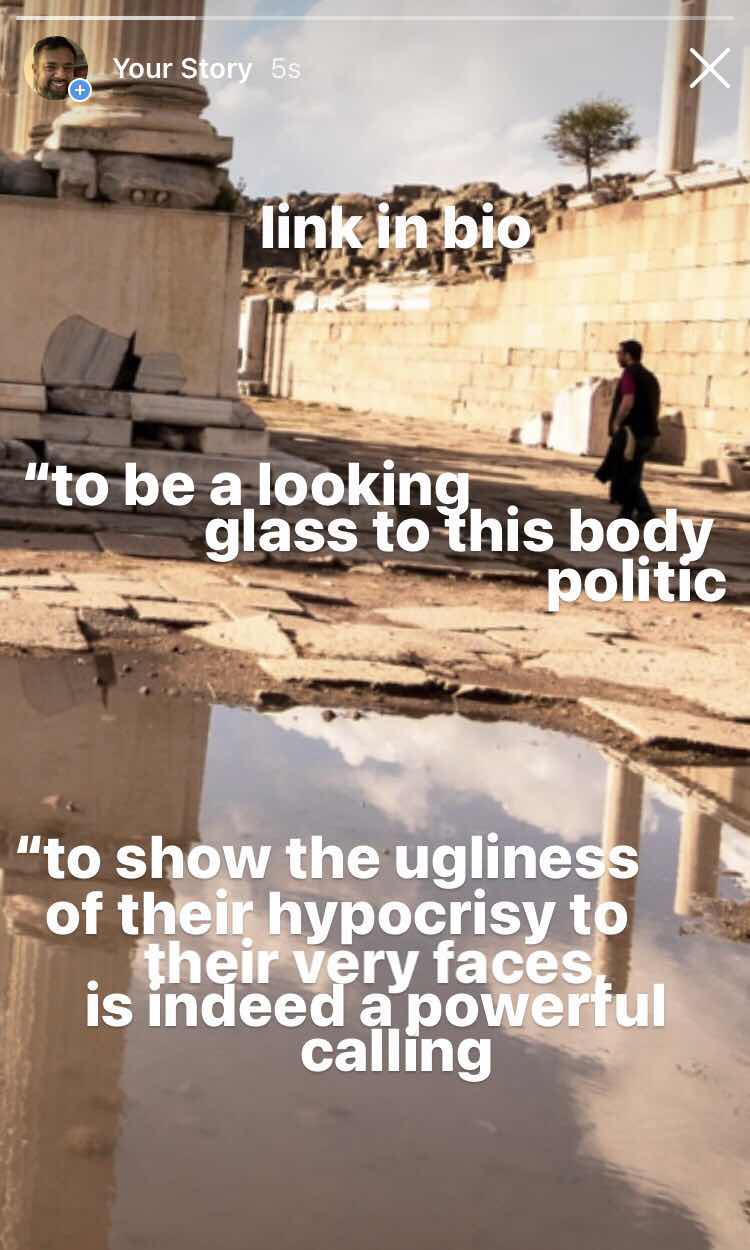
And it is our religion that holds that to be a looking glass for this body politic, and to hold up and show off the ugliness of their hypocrisy to their very faces, is a powerful calling. 

To do that with honour, ability and humanity, for all, is all that we should aspire to. 

That we might try our best to affect change, for the betterment of the World at large, for everyone from Africa to the Americas. 

And truth be told to the likes of our Scholars that wish for us to bury our heads in the sand, that democracy demands that we contribute. 

And what better way to contribute than to call out the hypocrisy of this false democracy, the hypocrisy that enslaves other countries to dictatorships, and then to be the standard bearers to a better- more inclusive- way. 

For holding out for truth and justice for others less fortunate than ourselves, who live on the other side of the world, should be part and parcel of this democracy. 

And we should be able to do so without fear of being labelled a fifth column, or a traitor. 

For far greater things bind us together, than separate us, because of where we live.

What I have said here is my opinion. If it is wrong then that wrong belongs to me. 
Knowledge is sought through study and contemplation, not via lectures, nor speeches, nor this. 

Shafees


Saturday, 16 February 2019

A religion of Miracles

Assalamu’alaikum brothers 
Jumaa Mubarak. 


Islam is a religion of miracles. 
It takes a particular mind set to see beyond the everyday, and to realise just how much we  take for granted, and how much we have to be thankful for. 

For some that religious mindset makes them feel special. Of itself that is not a problem, however we should all be wary that after a time that feeling can lead to the slow erosion of what started as humility. 

And it is only by God’s kind grace presenting us with chance circumstance that we can return back to that humility with gratitude. (David (as) and the litigants). 

This is the role that Jamaa’ (the collective) often plays within our collective psychology. 

For when the army of Muslims returned from Mutah, having proved themselves against a mightier Roman force, by a factor of ten, they were rebuked by the crowd on entry into Medina. The rebuke was ill founded but the Messenger (saw) took heart from it and saw in them an eagerness for their religion. 

(Do not believe the Wiki account online as it fails wrt to historical analysis and is at odds with the Muslim version of events). 

The recent controversies surrounding M&S toilet tissue, and Nike, are points in question. To disdain your Muslim brothers when they show eagerness to defend the faith, is not the Sunnah. And if you think that you are better than them, then perhaps you need to contemplate the Ahl al Saff mentioned within the first twenty verses of Baqara. 

For these have not overstepped the bounds. 
And political activism is something that every Muslim should aspire to in the making of a just and true society. 

However for some the religious mindset only makes them feel special, and causes them to disdain others, sometimes even their own Muslim brothers. And sometimes it is because they feel themselves better educated or more intelligent. 

Still others when they have stood to gain from the usurping of other’s rights, only see that act of wrong as an affirmation of their specialness. 

That God has enabled them to do so, to wrong another, as an affirmation that God is on their side. (Israel vs Palestine).

But this is not borne out when we study the life of the most special of men, Muhammed (saw) who came as a guide. 

Know that if GOD loves you, then He will prevent and stop you from wrong, or from the stealing of another’s right, even when it is a trifling sum. And at these times if there is clear intervention, a greater miracle cannot be wished for. 

For then God has seen fit to protect you from harm. Or from your harming another, or taking another’s right. 

And if the rope is made out for you, and it is made easy for you to wrong another, however slight, then use it at your own loss- and stop it, at your gain. 

For still others that want of being, and feeling special, causes them to invent and add things to the religion that do not belong. Embellishing that which needs none, both simple and beautiful as it stands. 

They do this as a means of making themselves “feel” more special than the rest of us. 

I have seen this happen on multi levels, from the over complication of Fiqh, to the heresies of some tasawuf (Sufi paths seeking closeness to God). To know their error, is not to disdain them, but neither is it to hold them in regard. 

In all cases, it is openness that is a cure for them, or for their folk. And that openness means accepting them for who they are and then moving on. 

The believers have a sacred trust in God that far outstrips worries over their particular version of the religion. For it is He who promised to keep this religion pure, and to explain it. 

The Islamic mindset should make you both grateful and humble, strong in adversity, true and just in all dealing with fellow man. 
If should make you appreciate the ahlul saff, the simple men, and their needs. 
The secret of contentment and happiness lies in nothing but the remembrance of GOD.  

And religiosity has its bounds. 
Do not overstep them, thinking that by it you become better than others. 
Stick to the Jamaa’, and make excuses for those of your brothers that do so too. 

What I have said here is my opinion. If it is wrong then that wrong belongs to me. 
Knowledge is sought through study and contemplation, not via lectures, nor speeches, nor this. 


Shafi.